
Imagine a product manager waiting three days for a report, while a finance leader needs an answer before the next meeting and an operations team is still relying on last month’s spreadsheet. The data exists. The questions are clear. Yet decisions are delayed because access to insights remains limited.
This is a common enterprise analytics challenge.
Self-service analytics enables employees to explore data, answer business questions, and generate insights without depending on technical teams for every request. But making it available is only the first step. The real challenge is scaling it across departments while maintaining data quality, security, and trust.
What Does It Mean to Scale Self-Service Analytics?
Scaling self-service analytics means enabling teams across an organization to access and analyze relevant data independently, using consistent definitions, governed access, and tools they can actually use.
Rather than limiting analytics to specialists, enterprises make data exploration accessible to business users in finance, sales, marketing, operations, product, and leadership.
The goal is not to replace data teams. It is to reduce repetitive requests, accelerate everyday decisions, and allow specialists to focus on complex analysis and strategic initiatives.
Why Do Enterprises Struggle to Scale Self-Service Analytics?
Many organizations invest in dashboards and business intelligence tools but still struggle to make analytics part of everyday work.
Common barriers include:
- Data silos: Information is spread across disconnected systems, databases, and applications.
- Technical complexity: Business users may lack SQL skills or knowledge of data models.
- Inconsistent definitions: Different teams may calculate the same metric differently.
- Limited trust: Incomplete or inconsistent data can undermine confidence in results.
- Governance concerns: Broader data access must not compromise security or compliance.
- Low adoption: Tools that feel complicated or disconnected from daily workflows often go unused.
To scale successfully, enterprises must address people, processes, data, and technology together.
7 Strategies to Scale Self-Service Analytics Across Teams
1. Start With Real Business Questions
Begin with the questions employees ask repeatedly, rather than introducing a platform and expecting teams to discover its value.
Sales may need pipeline visibility, finance may want to investigate revenue changes, and operations may need to identify performance bottlenecks. Prioritize high-value use cases where faster access to insights can make a measurable difference.
2. Connect Data Across the Enterprise
Self-service analytics cannot scale when users have to navigate disconnected data sources or rely on manual spreadsheet consolidation.
Connect relevant databases, cloud warehouses, and business systems while maintaining appropriate access controls. A more unified analytical experience helps teams investigate business questions using data from their existing environments.
3. Make Analytics Accessible to Nontechnical Users
Not every employee should need to learn SQL to answer a business question.
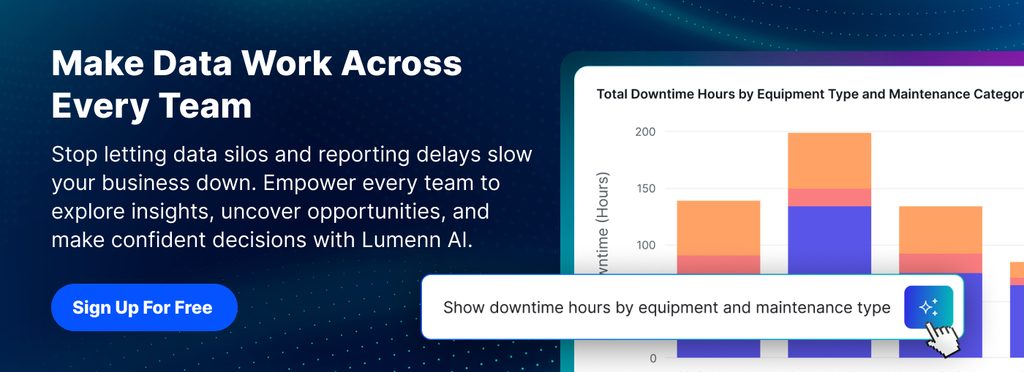
Natural language analytics and no-code interfaces allow users to ask questions in everyday language, generate visualizations, and explore trends with less technical assistance. The simpler the experience, the easier it becomes to integrate analytics into daily decisions.
4. Establish Shared Business Definitions
Scaling analytics across teams requires a common understanding of important metrics.
What counts as an active customer? How is revenue defined? Which calculation determines conversion rate?
A governed data dictionary and shared metric definitions help reduce ambiguity and keep teams aligned. When business terminology is documented clearly, users and AI-powered tools can interpret questions more consistently.
5. Build Data Quality and Governance Into the Process
Greater access to data must come with greater responsibility.
Enterprises should monitor missing values, duplicates, inconsistencies, and anomalies while establishing role-based permissions and appropriate oversight. Data quality checks help users understand potential issues, while governance ensures people access only the information they are authorized to use.
6. Turn Insights Into Shared Dashboards
Individual analysis becomes more valuable when teams can share important findings.
Encourage users to save relevant visualizations to dashboards, monitor key performance indicators, and collaborate around consistent views of business performance. Dashboards should complement exploration, not replace it: teams need both reliable monitoring and the flexibility to ask new questions.
7. Measure Adoption and Keep Improving
Successful implementation is not measured by licenses purchased or dashboards created.
Track meaningful indicators such as active users, time taken to answer common questions, reduced reporting bottlenecks, and adoption across departments. Gather feedback, provide practical training, and expand based on what teams actually use.
How AI Is Accelerating Enterprise Self-Service Analytics
AI is making analytics more conversational and accessible.
Instead of manually configuring a report, a business user can ask, “Which regions experienced the largest sales decline this quarter?” An AI-powered analytics platform can interpret the question, query relevant data, and present visualizations and explanations.
Users can then ask follow-up questions to explore the result further.
However, AI alone is not enough. Enterprises also need business context, reliable data, transparent analytical processes, and governance. Combining these capabilities helps organizations scale self-service analytics without sacrificing confidence or control.
How Lumenn AI Helps Enterprises Scale Self-Service Analytics
Lumenn AI is an AI-powered, no-code enterprise analytics platform that helps teams connect, query, validate, visualize, and understand data using natural language.
With Lumenn AI, employees can ask business questions without writing SQL and receive insights alongside relevant visualizations. Teams can pin visualizations to dashboards, making it easier to share findings and monitor business performance.
Its capabilities support enterprise-wide analytics adoption:
- Natural language analytics: Help nontechnical users explore data using everyday questions.
- Data source connectivity: Connect to supported enterprise databases, warehouses, and storage systems.
- AI-powered Data Quality: Identify issues such as nulls, duplicates, inconsistencies, schema mismatches, and anomalies.
- Data Dictionary: Add business definitions and context to support more consistent interpretations.
- SQL Refinery: View the SQL behind an AI-generated insight, refine it using natural language, and regenerate results.
- Chain of Thoughts: Access a structured explanation of how a question was interpreted, which data and logic were used, and how an insight was produced.
- Dashboards: Pin visualizations for ongoing monitoring and collaboration.
By bringing natural language exploration, data quality, business context, and transparency into one experience, Lumenn AI helps enterprises make analytics more accessible while keeping trust and control in focus.
Frequently Asked Questions
What is self-service analytics in an enterprise?
Self-service analytics allows employees to access, explore, and visualize business data independently, reducing their reliance on technical teams for routine analytical requests.
How can enterprises scale self-service analytics successfully?
Enterprises should connect relevant data sources, simplify analytics for nontechnical users, standardize business definitions, establish governance, monitor data quality, and measure adoption.
Does self-service analytics replace data analysts?
No. It reduces repetitive requests so analysts can focus on complex analysis, data modeling, governance, and strategic initiatives.
How does AI improve self-service analytics?
AI enables users to ask questions in natural language, generate visualizations, and explore follow-up questions without manually building every report or writing SQL.
How can enterprises maintain data security?
Organizations should implement role-based access controls, clear permissions, governance policies, and appropriate auditing while ensuring users only access authorized data.
Turn Enterprise Data Access Into Enterprise-Wide Impact
Scaling self-service analytics is not simply about giving more employees access to another tool. It is about building an environment where teams can confidently explore data, challenge assumptions, and make informed decisions without unnecessary delays.
With the right combination of accessible technology, trusted data, shared business context, and governance, analytics can become part of how every department works.