
In US FinTech, a few hours can change the outcome of a business decision.
A payment issue emerges. Customer activity shifts. Transaction volumes change. A product suddenly gains traction. A risk team notices an unusual pattern.
The question is no longer whether the data exists. It does.
The real question is: How quickly can FinTech teams turn that data into a decision?
That is where AI-powered analytics is changing the game. Instead of relying entirely on static reports, manual analysis, or technical teams for every question, US FinTechs are increasingly using AI to interact with data, uncover patterns, generate insights, and accelerate everyday decision-making.
What Is AI-Powered Analytics in FinTech?
AI-powered analytics combines enterprise data with artificial intelligence to help organizations analyze information, identify patterns, generate insights, and answer business questions more efficiently.
For FinTech companies, this can mean asking questions in natural language, automatically generating visualizations, identifying anomalies, understanding trends, and receiving predictive insights without requiring users to manually build every analysis.
The shift is significant: analytics moves from being something teams request to something they can explore when decisions need to be made.
Why Faster Decisions Matter for US FinTechs
US FinTechs operate across payments, lending, digital banking, wealth management, insurance, embedded finance, and financial infrastructure. Across these areas, decisions increasingly depend on large volumes of customer, transaction, operational, and financial data.
But more data can also create more complexity.
Disconnected systems, lengthy reporting cycles, technical dependencies, and inconsistent data can slow down the journey from question to answer.
AI-powered analytics helps shorten that journey.
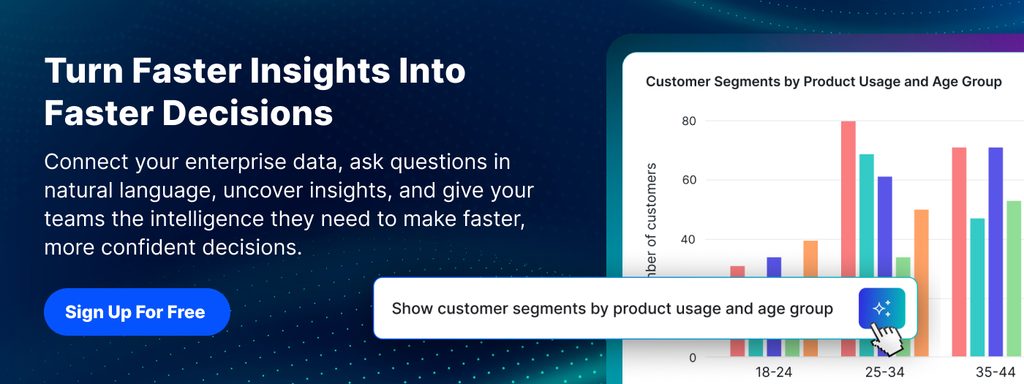
For example, instead of waiting for an analyst to prepare a report, a product leader could ask:
“Which customer segments have seen the biggest increase in product usage this quarter?”
The ability to get an answer quickly can help teams investigate the underlying trend while it is still relevant.
How US FinTechs Are Using AI-Powered Analytics
1. Understanding Customer Behavior
Customer expectations in financial services are changing rapidly. FinTechs need to understand who is using their products, how they are using them, and where engagement is changing.
AI-powered analytics can help teams explore customer behavior across demographics, products, locations, transaction activity, and engagement.
Questions such as “Which customer segments are becoming more active?” or “Where are customers dropping off during onboarding?” can reveal opportunities to improve products and experiences.
2. Monitoring Transactions and Payment Performance
For payment-focused FinTechs, transaction data is a constant source of business intelligence.
Teams can analyze transaction volumes, payment success rates, failure reasons, geographic trends, and revenue patterns.
Instead of simply seeing that failed payments increased, teams can investigate where the increase happened and which customer or transaction segments were affected.
That moves analytics from monitoring numbers to understanding business impact.
3. Supporting Fraud and Risk Teams
Fraud and risk management require organizations to identify unusual behavior quickly.
AI-powered analytics can help teams explore transaction patterns, customer activity, regional changes, and anomalies that may require investigation.
For example:
“Show unusual transaction activity by region over the past 30 days.”
The resulting analysis can help risk teams investigate emerging patterns faster.
AI does not eliminate the need for specialist risk controls or human judgment. Instead, it can help teams reach the right information faster.
4. Improving Lending and Credit Decisions
Lending FinTechs work with customer profiles, applications, repayment behavior, loan portfolios, and financial information.
AI-powered analytics can help teams understand approval patterns, portfolio performance, repayment trends, and risk distributions.
Predictive insights can also help teams identify patterns that deserve further investigation.
The important point is not simply generating another score or model output. It is giving business teams a clearer understanding of what is happening across the lending portfolio.
5. Accelerating Product Decisions
FinTech product teams constantly ask questions about adoption and engagement.
Which features are customers using? Which products are gaining traction? Which customer groups are engaging differently?
AI-powered analytics enables product teams to investigate these questions without turning every request into a technical project.
A product manager can start with:
“Which features are most used by enterprise customers?”
Then continue the analysis:
“How has usage changed over the last six months?”
This conversational approach makes data exploration more natural and iterative.
From Dashboards to Conversational Analytics
Traditional dashboards remain valuable for tracking established KPIs.
But dashboards cannot anticipate every question a business will ask tomorrow.
That is why conversational analytics is becoming increasingly important.
Instead of navigating multiple filters and reports, users can ask questions in natural language and continue exploring the results.
Modern enterprise analytics platforms are increasingly moving toward this model, combining natural-language queries with visualizations, business context, and governed access to enterprise data.
The result is a more flexible analytics experience where business users can investigate data as their questions evolve.
Why Trust and Data Quality Matter
Speed is valuable, but speed without trust can create new problems.
US financial institutions face increasing attention around AI governance, data access, third-party risk, privacy, and human oversight.
For AI-powered analytics to deliver lasting value, FinTechs need more than intelligent models.
They need reliable data.
Capabilities such as data quality checks, business definitions, permissions, audit logs, and explainable analytical workflows can help organizations use AI more responsibly.
This is particularly important when insights influence financial, operational, risk, or compliance decisions.
How Lumenn AI Helps US FinTechs Make Faster Data-Driven Decisions
Lumenn AI is an AI-powered, no-code enterprise analytics platform that helps banking and FinTech teams connect, query, validate, visualize, and understand complex financial data using natural language.
Instead of requiring users to write SQL for every question, Lumenn AI lets teams ask questions in plain language and receive AI-generated insights and visualizations.
FinTech teams can use it to explore customer segmentation, transaction trends, revenue performance, fraud and anomaly patterns, loan portfolio insights, compliance metrics, and operational efficiency.
Lumenn AI also brings important capabilities around data quality and business context. Its AI-powered Data Quality features can identify issues such as missing values, duplicates, inconsistencies, and anomalies, while a Data Dictionary helps provide business definitions that improve the context available to AI.
With SQL Refinery, users can view the SQL logic behind an AI-generated insight and refine it using natural language before regenerating the result. This gives business users greater control without requiring them to manually write SQL.
With Chain of Thoughts, users can access a structured explanation of how an analytical question was interpreted, what data sources and logic were used, and how the resulting insight was generated.
Together, these capabilities help bring speed, accessibility, transparency, and control into one enterprise analytics workflow.
What Does the Future Look Like for AI-Powered FinTech Analytics?
The next evolution of FinTech analytics is not simply about producing more reports.
It is about shortening the distance between a business question and a confident decision.
AI-powered analytics can help teams explore data faster, uncover important patterns, generate predictive insights, and investigate changes while they are still actionable.
For US FinTechs competing on speed, customer experience, operational efficiency, and innovation, that difference can become a meaningful competitive advantage.
The winning approach will not be AI without oversight. It will be AI combined with trusted data, human judgment, business context, and strong governance.
Frequently Asked Questions
What is AI-powered analytics in FinTech?
AI-powered analytics uses artificial intelligence to help FinTech teams analyze enterprise data, answer business questions, identify patterns, and generate actionable insights faster.
How does AI help FinTechs make faster decisions?
AI can automate parts of data exploration, generate insights and visualizations, and allow users to ask questions in natural language instead of waiting for manual analysis.
Can nontechnical FinTech teams use AI-powered analytics?
Yes. No-code and natural-language analytics platforms allow business users to explore data without requiring advanced SQL or programming skills.
What FinTech use cases benefit from AI-powered analytics?
Common use cases include customer segmentation, transaction monitoring, fraud investigation, lending analysis, revenue tracking, product analytics, compliance, and operational performance.
Why is data quality important for AI analytics?
AI-generated insights depend on the quality and context of the underlying data. Data quality checks help identify issues that could affect analytical results and decision-making.