
Every business generates data. Sales teams rely on CRM platforms, finance works with ERP systems, marketing tracks campaign performance across multiple tools, while operations monitor databases, cloud storage, and internal applications.
The challenge isn’t collecting data anymore—it’s connecting it.
When information is spread across disconnected systems, organizations struggle to see the complete picture. Teams make decisions based on partial information, reports take longer to prepare, and valuable business opportunities are often missed.
This is where multi-source analytics changes the game.
By bringing data from multiple systems into a unified analytics experience, businesses can break down data silos, improve collaboration, and make decisions with greater confidence.
In this blog, we’ll explore why data silos exist, how multi-source analytics solves them, and why it’s becoming an essential capability for modern enterprises.
What Are Data Silos?
A data silo occurs when information is stored in isolated systems that cannot easily communicate with one another.
For example:
- Customer data lives in a CRM.
- Sales reports are stored in a data warehouse.
- Inventory information is managed through ERP software.
- Product usage data comes from application databases.
- Financial data resides in another platform.
Although each department has access to its own information, very few organizations have a unified way to analyze everything together.
The result is fragmented decision-making.
Why Data Silos Are a Business Challenge
Disconnected data affects more than reporting. It impacts how quickly organizations can respond to changing business conditions.
Common challenges include:
- Different teams working with different versions of the truth
- Slow report generation due to manual data collection
- Limited visibility across departments
- Duplicate analysis efforts
- Delayed business decisions
- Increased dependency on technical teams
Without connected analytics, leaders often spend more time finding data than acting on it.
What Is Multi-Source Analytics?
Multi-source analytics is the ability to connect and analyze data from multiple databases, cloud platforms, storage systems, and enterprise applications within a single analytics environment.
Instead of switching between different tools, users can explore information from all connected sources through one interface.
The result is a complete, organization-wide view of business performance.
Why Multi-Source Analytics Is Becoming Essential
Modern businesses operate across dozens of platforms. Customers interact through multiple channels, products generate usage data continuously, and operational systems produce real-time information.
Analytics platforms must keep up.
Organizations now expect analytics solutions that can:
- Connect multiple enterprise data sources
- Deliver real-time insights
- Eliminate manual exports
- Reduce reporting delays
- Support self-service analytics
- Scale across departments
Multi-source analytics has become the foundation for enterprise-wide intelligence.
Key Benefits of Multi-Source Analytics
Complete Business Visibility
Instead of viewing departments independently, organizations gain a unified perspective.
Sales, marketing, finance, customer support, and operations can all contribute to a single analytical view.
Leaders no longer need to compare multiple reports before making decisions.
Faster Decision-Making
When data is already connected, analysis becomes significantly faster.
Business users can ask questions immediately instead of waiting for reports to be prepared.
This accelerates decision-making across every department.
Better Collaboration Across Teams
Shared analytics encourages collaboration.
When everyone works from the same data foundation, conversations shift from validating numbers to discussing business strategy.
Cross-functional teams become more aligned.
Real-Time Business Intelligence
Multi-source analytics enables organizations to analyze live operational data instead of relying on yesterday’s reports.
This allows businesses to:
- Monitor KPIs continuously
- Detect anomalies earlier
- Respond faster to operational changes
- Improve forecasting accuracy
Real-time intelligence creates a competitive advantage.
Reduced IT Dependency
Traditionally, combining multiple data sources required technical expertise.
Modern analytics platforms simplify this process through intelligent connectors and natural language querying.
Business users become more self-sufficient while IT teams focus on strategic initiatives.
Common Enterprise Use Cases
Executive Performance Dashboards
Combine finance, sales, marketing, and operations into a single executive dashboard for complete organizational visibility.
Customer 360 Analytics
Merge CRM data, support tickets, marketing campaigns, and product usage to better understand customer behavior.
Revenue Performance Analysis
Connect sales pipelines, invoices, subscriptions, and financial systems to identify growth opportunities.
Supply Chain Visibility
Analyze inventory, logistics, procurement, and manufacturing metrics together to improve operational efficiency.
Product and Customer Insights
Connect application databases with customer engagement metrics to understand feature adoption, retention, and user behavior.
How Lumenn AI Simplifies Multi-Source Analytics
Modern enterprises need more than data connectors. They need an analytics platform that makes connected data easy to explore for every team.
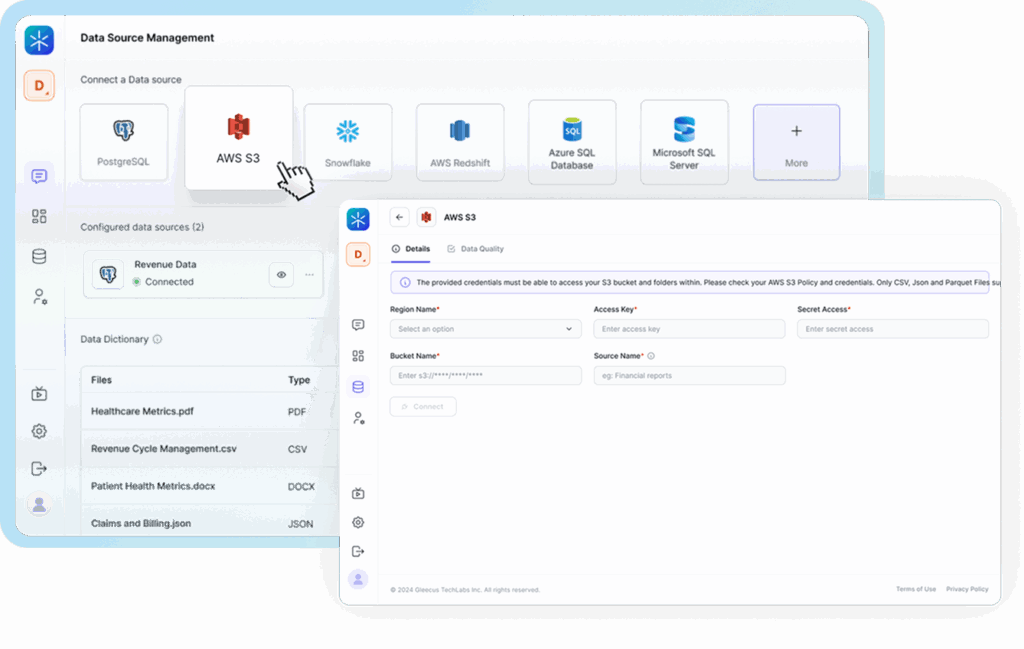
Lumenn AI is designed to eliminate data silos by securely connecting multiple enterprise data sources into a unified, AI-powered analytics experience.
With Lumenn AI, organizations can connect platforms such as PostgreSQL, MySQL, Snowflake, Amazon Redshift, Google BigQuery, Azure SQL, AWS S3, Azure Blob Storage, and many other enterprise data sources without moving their data.
Once connected, users can simply ask questions in natural language and receive instant charts, dashboards, and business insights.
Lumenn AI also includes powerful capabilities that help organizations maximize the value of connected data:
- Secure multi-source data integration
- Natural language business queries
- AI-generated visualizations and dashboards
- Self-service analytics for business users
- AI-powered Data Quality checks
- Data Dictionary for business context
- Enterprise-grade security and governance
- AI Auto Analyst for proactive data exploration
- SQL Refinery for refining AI-generated SQL using natural language
- Chain of Thoughts for transparent, explainable AI reasoning
By combining multiple data sources with conversational analytics, Lumenn AI empowers every employee—not just data specialists—to make faster, smarter decisions from trusted enterprise data.
Best Practices for Successful Multi-Source Analytics
Choose Secure Integrations
Ensure your analytics platform connects using secure, read-only access without unnecessary data movement.
Standardize Business Definitions
Use a centralized Data Dictionary so every team interprets metrics consistently.
Monitor Data Quality
Connected analytics is only valuable when the underlying data is accurate and reliable.
Empower Business Users
Provide intuitive, no-code analytics so every department can explore data independently.
Prioritize Governance
Implement role-based access, audit logs, and transparent AI processes to maintain trust across the organization.
The Future of Enterprise Analytics
Data silos are becoming one of the biggest barriers to business growth.
As organizations continue adopting AI, cloud platforms, and digital transformation initiatives, connected analytics will become the standard rather than the exception.
The future belongs to businesses that can unify data, democratize access, and enable every employee to make informed decisions from a single source of truth.
Multi-source analytics isn’t simply about connecting databases.
It’s about connecting people, processes, and decisions.
Break Down Data Silos with Lumenn AI
Disconnected data shouldn’t slow your business down.
With Lumenn AI, you can securely connect multiple enterprise data sources, explore information using natural language, build interactive dashboards, and generate trusted insights—all without writing code.
Whether you’re analyzing customer behavior, tracking operational performance, or combining data across departments, Lumenn AI helps you transform scattered information into actionable business intelligence.