
Every organization wants to make smarter decisions. Yet, in many enterprises, getting a simple business question answered can still involve multiple teams, technical requests, complex reports, and long waiting periods.
A business leader wants to understand why revenue has changed. An operations head needs to identify performance gaps. A product team wants to investigate customer behavior. The data may already exist, but accessing the right insight is not always easy.
For Chief Information Officers (CIOs), this creates an important challenge: How can organizations make better use of their data without creating more complexity for IT teams?
Self-service analytics offers a practical answer. By enabling business users to explore data and generate insights independently, CIOs can help make analytics more accessible, responsive, and connected to everyday business decisions.
What Is Self-Service Analytics?
Self-service analytics is an approach that enables employees to access, explore, analyze, and visualize enterprise data without depending on technical teams for every reporting request.
Modern platforms use no-code interfaces, AI-powered analysis, and natural language queries to make data exploration easier for nontechnical users.
Instead of submitting a request for every question, employees can ask questions such as:
- Which business units experienced the highest growth this quarter?
- What factors are contributing to declining customer engagement?
- How has operational performance changed across regions?
The goal is not to replace data analysts or IT teams. It is to reduce repetitive requests and allow specialists to focus on complex analysis, architecture, governance, and strategic initiatives.
Why Should CIOs Prioritize Self-Service Analytics?
CIOs are responsible for more than maintaining technology infrastructure. They play a critical role in aligning technology investments with business objectives.
However, when analytics access is limited to a small group of specialists, decision-making can become dependent on reporting queues and predefined dashboards.
Self-service analytics helps CIOs address this gap by:
- Improving decision speed: Business teams can investigate questions without waiting for every report.
- Reducing IT workload: Fewer repetitive data requests allow technical teams to prioritize strategic work.
- Increasing data adoption: More employees can use enterprise data in their daily responsibilities.
- Supporting business agility: Teams can explore emerging trends and changing requirements more quickly.
- Strengthening data culture: Decisions become more informed by evidence rather than assumptions.
For CIOs, the opportunity is to make enterprise data a practical resource across the organization.
6 Ways CIOs Can Drive Data-Driven Decisions with Self-Service Analytics
1. Democratize Access to Enterprise Data
Data should not remain accessible only to employees with technical expertise. CIOs can introduce governed self-service analytics that allows departments such as finance, marketing, operations, and product to explore relevant information independently.
When employees can answer routine questions themselves, analytics becomes part of everyday work rather than a specialized activity.
2. Reduce Dependency on IT and Data Teams
Technical teams often spend considerable time preparing reports, modifying queries, and responding to recurring requests.
Self-service analytics reduces this operational burden by allowing business users to handle routine exploration. IT and data professionals can then dedicate more time to data infrastructure, advanced analytics, security, and innovation.
3. Enable Faster, More Informed Decisions
Business conditions change constantly. Leaders need the flexibility to investigate new questions rather than rely entirely on reports designed weeks earlier.
With self-service analytics, teams can explore performance trends, compare business units, and investigate unexpected changes as they arise. This helps decision-makers move from identifying what happened to understanding what deserves attention next.
4. Build a Strong Data Governance Framework
Greater access to data must come with appropriate control.
CIOs should establish role-based access, permissions, auditability, and clear data ownership. Employees should only access information relevant to their responsibilities.
A well-governed self-service environment balances accessibility with security, helping organizations expand analytics adoption without losing oversight.
5. Improve Data Quality and Consistency
More users exploring data makes reliable information even more important. Missing values, duplicate records, inconsistent definitions, and outdated information can lead to misleading conclusions.
CIOs should prioritize data quality checks and establish shared business definitions through data dictionaries and metadata practices. This helps teams interpret metrics consistently and make decisions with greater confidence.
6. Encourage an Organization-Wide Data Culture
Technology adoption succeeds when people use it to solve real problems.
CIOs can encourage adoption by introducing self-service analytics through practical business use cases, providing employee training, and demonstrating how teams can turn questions into insights.
Over time, this creates a culture where employees are encouraged to investigate, validate, and use data before making important decisions.
How AI Is Transforming Self-Service Analytics
AI is taking self-service analytics beyond traditional dashboards and drag-and-drop reporting.
With natural language analytics, users can ask questions in everyday language instead of manually writing SQL or configuring complex queries.
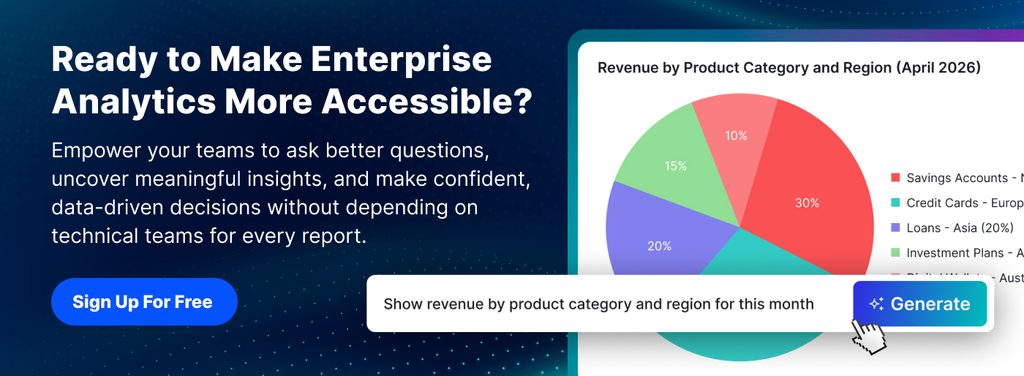
For example, a business leader could ask, “Show revenue trends by region over the last six months.” The platform can interpret the request, query the relevant data, and generate visual insights.
Users can then ask follow-up questions to investigate specific trends.
This conversational approach makes analytics more accessible, particularly for employees who understand business requirements but lack technical query skills.
For CIOs, AI-powered analytics can help bridge the gap between enterprise data infrastructure and business users. However, explainability, governance, and data quality remain essential for responsible adoption.
How Lumenn AI Helps CIOs Build a Self-Service Analytics Environment
Lumenn AI is an AI-powered, no-code enterprise analytics platform designed to help organizations connect, query, validate, visualize, and understand their data using natural language.
For CIOs looking to make enterprise analytics more accessible, Lumenn AI brings several capabilities into one experience.
- Natural Language Analytics: Employees can ask business questions in plain language and generate textual insights and visualizations without writing SQL.
- Enterprise Data Connectivity: Connect data sources such as PostgreSQL, MySQL, Snowflake, Amazon Redshift, Google BigQuery, Azure SQL, AWS S3, and Azure Blob Storage.
- AI-Powered Data Quality: Identify nulls, duplicates, inconsistencies, schema mismatches, and anomalies to support more reliable analysis.
- Data Dictionary: Add business definitions and metric context to help AI interpret organizational terminology more consistently.
- No-Code Dashboards: Pin generated visualizations to dashboards, collaborate with teams, and configure automatic refresh intervals.
- SQL Refinery: View the SQL behind AI-generated insights and refine its logic using natural language before regenerating results.
- Chain of Thoughts: Access a structured explanation of how a question was interpreted, which data sources and logic were used, and how the resulting insight was produced.
Together, these capabilities help CIOs support wider analytics adoption while maintaining visibility, control, and trust.
With Lumenn AI, enterprise teams can spend less time waiting for reports and more time exploring the questions that move business forward.
Frequently Asked Questions
1. How does self-service analytics help CIOs?
It helps CIOs improve data accessibility, reduce repetitive IT requests, increase analytics adoption, and support faster business decisions.
2. Does self-service analytics replace business intelligence teams?
No. It complements BI teams by reducing routine reporting requests and allowing specialists to focus on advanced analytics, governance, and strategic projects.
3. Is self-service analytics secure for enterprises?
It can be, provided the platform and implementation support appropriate access controls, permissions, encryption, auditing, and governance policies.
4. How does AI improve self-service analytics?
AI enables users to ask questions in natural language, generate insights and visualizations, and explore data without needing advanced technical skills.
5. What should CIOs consider before adopting self-service analytics?
CIOs should evaluate data connectivity, security, governance, data quality, business context, usability, scalability, and transparency of AI-generated insights.
Conclusion: Turn Enterprise Data into a Strategic Advantage
For CIOs, the next step in digital transformation is not simply collecting more data or building more dashboards. It is making existing data more accessible, understandable, and useful across the organization.
Self-service analytics helps achieve this by bringing insights closer to the people making decisions. With AI-powered exploration, reliable data, and strong governance, organizations can reduce analytical bottlenecks and build a more responsive data culture.
The real measure of success is not how much data an enterprise stores. It is how effectively its people use that data to move the business forward.