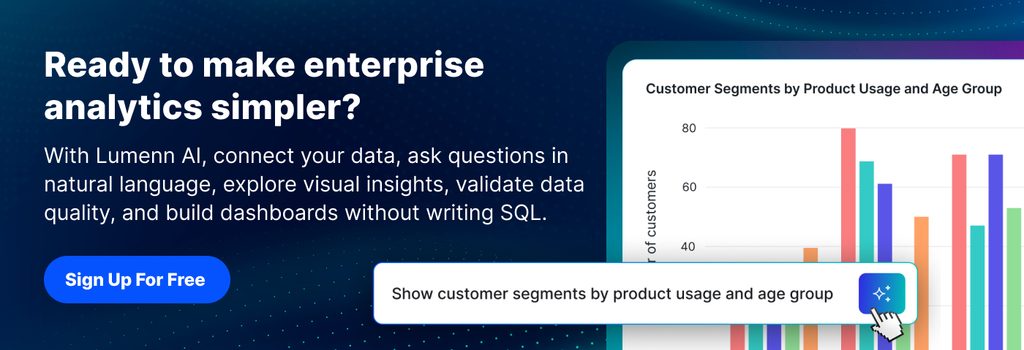

Imagine asking your business data a question and getting an answer, a visualization, and a clear explanation in seconds. No waiting for reports. No complicated queries. Just insights when decisions need to happen.
That is the direction data analytics is heading in 2027.
As organizations generate more data, the challenge is no longer simply collecting it. Businesses need tools that make information accessible, trustworthy, and actionable. AI-powered analytics, conversational interfaces, automated insights, and stronger data governance are reshaping how teams work with information.
In this guide, we explore the best data analytics tools to consider in 2027, their key strengths, and the trends businesses should watch when planning their analytics strategy.
Best Data Analytics Tools to Watch in 2027
The right platform depends on your data infrastructure, technical expertise, business goals, and governance requirements. Here are six tools worth evaluating.
Lumenn AI: Best for Conversational, Self-Service Enterprise Analytics
Lumenn AI is an AI-powered, no-code enterprise analytics platform that helps business users connect, query, validate, and visualize enterprise data using natural language. Instead of writing SQL or waiting for custom reports, users can ask business questions and receive insights, charts, and tables.
Its capabilities include AI-powered Data Quality, contextual business definitions through a Data Dictionary, automatically suggested questions with Auto Analyst, and dashboards that can refresh at scheduled intervals. SQL Refinery lets users refine AI-generated SQL using natural language, while Chain of Thoughts provides a structured explanation of how an insight was generated.
Lumenn AI is particularly relevant for organizations looking to make analytics accessible beyond specialist data teams while maintaining transparency and control.
Explore: Lumenn AI
ThoughtSpot: Best for Search-Driven Analytics
ThoughtSpot focuses on making analytics conversational. Its AI analyst, Spotter, helps users ask business questions in natural language, investigate trends, explore follow-up questions, and uncover performance drivers.
Its governed analytics approach connects answers to defined business metrics and underlying query logic. This can be valuable for enterprises that want self-service exploration without losing consistency across departments.
ThoughtSpot is worth considering if search-led analytics and AI-assisted business intelligence are priorities.
Explore: ThoughtSpot
Microsoft Power BI: Best for Microsoft-Centric Organizations
Microsoft Power BI is a popular business intelligence platform for building interactive reports, dashboards, and data visualizations. Its integration with the Microsoft ecosystem makes it attractive to organizations already using Microsoft Fabric, Excel, Azure, and Microsoft 365.
Copilot adds generative AI capabilities, supporting tasks such as exploring data, summarizing reports, and assisting with DAX expressions. Availability depends on the specific feature, licensing, and environment.
Power BI is a strong candidate for businesses seeking connected reporting and analytics within an established Microsoft technology stack.
Explore: Microsoft Power BI
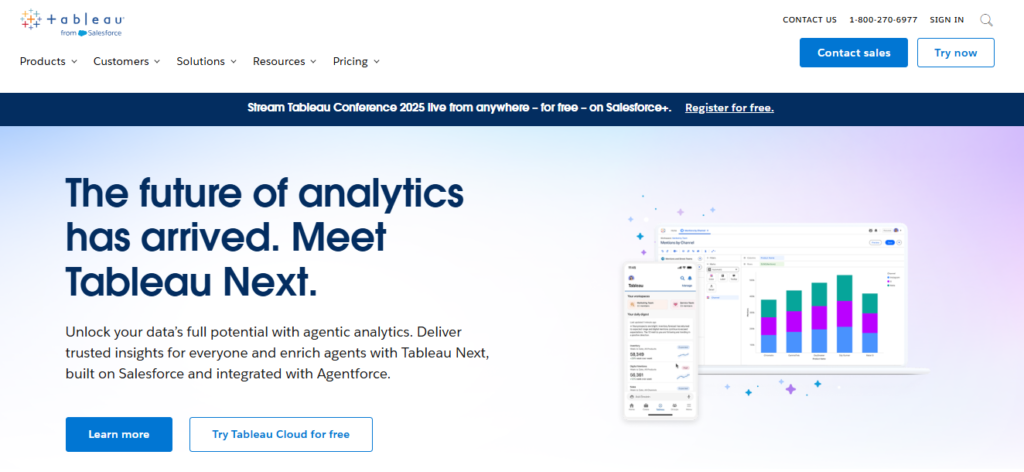
Tableau: Best for Visual Analytics and Data Storytelling
Tableau is known for interactive visualizations and helping users communicate complex information through data storytelling. It supports detailed exploration of trends, relationships, and business performance.
Tableau Pulse and Tableau Agent bring AI-assisted summaries, metric insights, visualization creation, and data exploration into the experience. These capabilities can help teams move beyond viewing charts toward understanding what deserves attention.
Tableau is worth evaluating when visual analysis, exploration, and communicating insights to stakeholders are central requirements.
Explore: Tableau
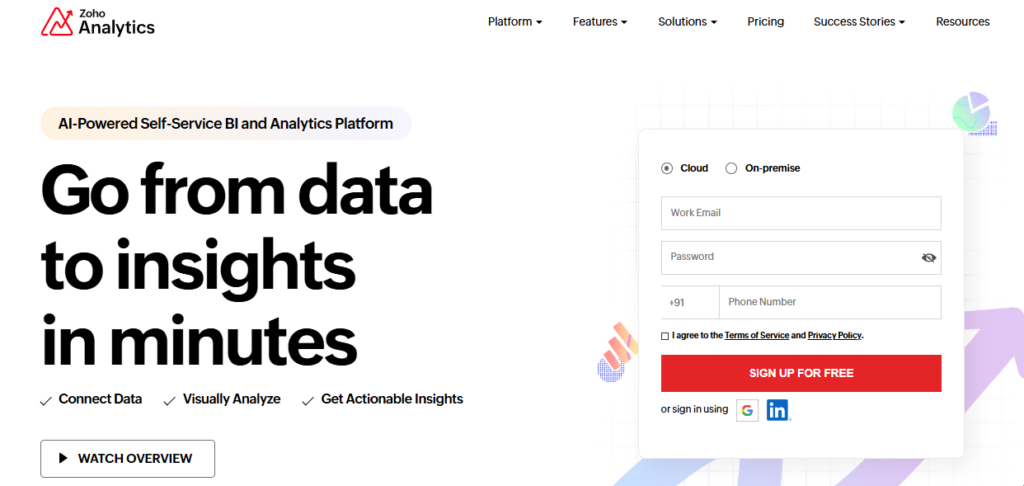
Zoho Analytics: Best for Accessible Business Reporting
Zoho Analytics combines data integration, visualization, reporting, and self-service business intelligence. It supports data from business applications, databases, files, and other sources.
Its AI assistant and newer agentic analytics capabilities aim to simplify analysis, dashboard creation, and insight discovery. Organizations already using Zoho applications may find its broader ecosystem particularly useful.
Zoho Analytics is a practical option for teams seeking reporting and analytics capabilities alongside business application integrations.
Explore: Zoho Analytics
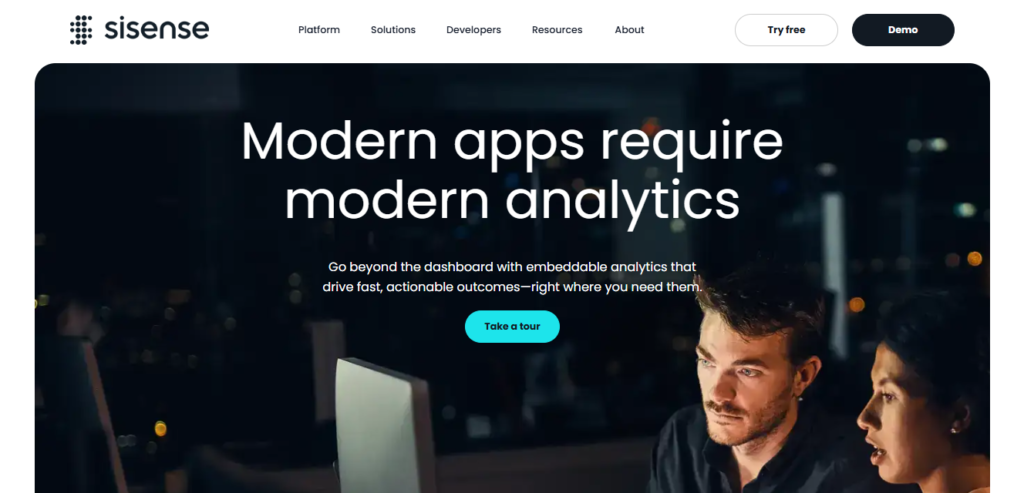
Sisense: Best for Embedded Analytics
Sisense helps businesses integrate analytics directly into their own applications and customer-facing products. Its developer-oriented capabilities support customized dashboards, embedded visualizations, and AI-powered analytical experiences.
This makes it relevant for software companies that want to offer analytics as part of their product rather than sending customers to a separate BI platform.
Explore: Sisense
These tools serve different needs rather than representing a universal ranking. Evaluate each against your use cases, integrations, security requirements, and total cost of ownership.
Top Data Analytics Trends to Watch in 2027
The next phase of analytics is about more than producing dashboards. It is about helping people understand what is happening, why it matters, and what to investigate next.
1. Agentic AI and Autonomous Analytics
AI is moving beyond answering individual questions toward agents that can plan analytical steps, investigate patterns, and support workflows. Gartner’s 2027 data and analytics outlook highlights agentic analytics, semantic foundations, and integrated platforms as major themes.
For businesses, this could mean less time spent manually searching for changes and more proactive identification of issues and opportunities. Human oversight remains essential when AI-generated findings influence important decisions.
2. Natural Language Analytics Goes Mainstream
Business users increasingly expect to ask questions in everyday language instead of learning complex analytical interfaces.
Questions such as “Why did revenue decline last month?” or “Which customer segment is growing fastest?” can become starting points for interactive exploration.
In 2027, natural language analytics will be an important capability to evaluate, especially for organizations looking to reduce reporting bottlenecks and expand self-service access.
3. Explainable AI and Trusted Insights
Fast answers are useful only when people can assess whether they make sense.
Organizations will need greater visibility into how AI interprets questions, applies filters, uses business definitions, and produces analytical results. Gartner’s 2027 outlook also emphasizes decision governance and AI governance as organizations expand AI-driven operations.
Transparency, validation, access controls, and auditability will therefore be critical considerations when choosing AI analytics tools.
4. Real-Time and Proactive Intelligence
Traditional reporting often relies on scheduled updates. Increasingly, businesses want to identify changes as they happen.
Streaming data and proactive monitoring can help teams respond to payment failures, operational delays, customer behavior changes, or unexpected performance shifts sooner. The most useful approach depends on whether a business needs genuine real-time processing or whether scheduled refreshes are sufficient.
5. Semantic Layers and Business Context
AI cannot reliably interpret every business term without context. Metrics such as “active customer,” “net revenue,” or “qualified lead” may have organization-specific definitions.
Semantic layers and well-maintained data dictionaries help establish shared definitions, relationships, and business rules. This reduces ambiguity and makes analytical results more consistent across teams.
6. Data Quality and AI Governance Become Essential
As more employees use AI analytics, poor data quality can spread misleading conclusions faster.
Businesses should prioritize completeness, consistency, accuracy, anomaly detection, access permissions, and monitoring of AI-generated outputs. Strong governance makes self-service analytics more scalable without sacrificing accountability.
7. Embedded Analytics Becomes Part of Everyday Work
Analytics is increasingly being integrated into the applications where people already work. Rather than switching between tools, employees and customers can access relevant metrics inside business software, operational platforms, and digital products.
This trend is especially important for SaaS companies that want to make analytics part of their product experience.
How to Choose the Right Data Analytics Tool in 2027
Before investing, ask five practical questions:
- Who will use it? Business users may prioritize no-code exploration, while analysts may need advanced modeling and customization.
- Where does your data live? Check native connectors, live-query options, and integration requirements.
- Can you trust the answers? Evaluate data quality, business definitions, explainability, and validation.
- Does it fit your governance model? Review permissions, security, auditing, and data handling.
- Will it grow with your needs? Consider collaboration, embedded analytics, scalability, and total cost.
The best data analytics platform is not necessarily the one with the longest feature list. It is the one that helps your organization answer important questions reliably and act on the results.
Frequently Asked Questions
What are the best data analytics tools for 2027?
Lumenn AI, ThoughtSpot, Microsoft Power BI, Tableau, Zoho Analytics, and Sisense are options to evaluate. The right choice depends on whether you prioritize conversational analytics, enterprise reporting, visualization, or embedded analytics.
What is the biggest data analytics trend in 2027?
Agentic AI is a major trend, alongside natural language analytics, semantic context, proactive intelligence, and stronger AI governance. Adoption should be guided by measurable business value and appropriate oversight.
How is AI changing data analytics?
AI helps users ask questions in natural language, generate visualizations, summarize findings, and automate parts of analytical workflows. Reliable data and validation remain essential.
What is self-service analytics?
Self-service analytics enables business users to explore data and generate insights with less dependence on technical teams for routine reporting requests.
Why is data governance important for AI analytics?
Governance helps ensure that data access is controlled, business metrics are consistently defined, and AI-generated results can be reviewed and validated.
Final Thoughts: Make 2027 the Year Your Data Works Smarter
The future of analytics is moving beyond static reports toward experiences that are conversational, proactive, contextual, and transparent.
The opportunity is not simply to adopt another tool. It is to help more people make informed decisions with data they can understand and trust.