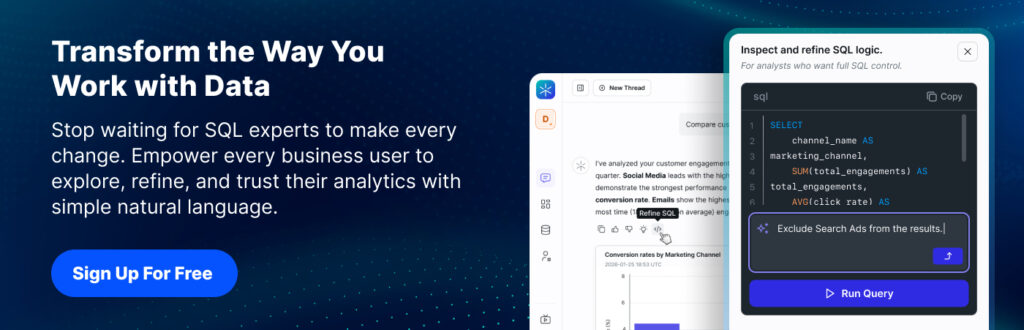

For years, SQL has been the language that powered business intelligence. It enables organizations to retrieve, filter, aggregate, and analyze data stored across enterprise databases. While SQL is incredibly powerful, it has also created a dependency on technical teams. Business users often know what they want to analyze but not how to write the SQL needed to get there.
As organizations embrace AI-powered analytics, this gap is beginning to disappear.
Today, business users no longer need to learn SQL to refine reports or explore data. Instead, they can simply describe the changes they want in plain English, while AI translates those requests into optimized SQL queries behind the scenes.
This new approach is transforming enterprise analytics by making data exploration faster, more collaborative, and accessible to everyone.
Why SQL Has Traditionally Been a Barrier
SQL was designed for developers, analysts, and database professionals. Although it provides complete control over data retrieval, it requires technical expertise that many business users simply don’t have.
Even small modifications often require understanding database schemas, joins, filtering conditions, grouping, and aggregation.
Common requests like these frequently require SQL changes:
- Show data only for the last three months
- Exclude cancelled orders
- Group sales by region instead of city
- Display only the top 20 products
- Compare this year’s revenue with last year
For many organizations, these simple requests create unnecessary dependencies on data teams.
The Business Challenge
Modern businesses move quickly.
- Marketing teams need campaign insights.
- Finance teams monitor revenue daily.
- Sales leaders track pipeline performance.
- Operations teams analyze efficiency metrics.
Waiting for someone to rewrite SQL slows decision-making and creates bottlenecks across departments.
Organizations need analytics platforms that empower business users without sacrificing accuracy or governance.
What Does It Mean to Modify SQL Without Writing SQL?
Instead of manually editing SQL syntax, users simply explain the change they want.
For example:
Original question:
“Show monthly revenue.”
Refinement:
“Only include the last four quarters and exclude cancelled invoices.”
Behind the scenes, AI updates the SQL query, executes it, and regenerates the visualization and insights.
The user never touches SQL.
The experience feels conversational while maintaining the power of traditional analytics.
Benefits of Natural Language SQL Refinement
Faster Analysis
Business users can refine reports in seconds instead of waiting for technical support or manually rebuilding dashboards.
Greater Confidence
Users understand exactly what changes are being applied without worrying about SQL syntax or query errors.
More Flexibility
Analytics becomes interactive. Users can experiment with different filters, time ranges, conditions, and groupings until they find the answers they need.
Reduced Dependency on Technical Teams
Data analysts can focus on strategic initiatives instead of handling repetitive query modification requests.
Improved Collaboration
Business users and analysts work from the same data while communicating in business language instead of technical code.
Common SQL Changes Business Users Can Make
Modern AI analytics platforms make it easy to refine queries using simple instructions such as:
Time-Based Changes
- Show only the previous quarter
- Compare the last two years
- Exclude weekends
- Display year-to-date performance
Filter Adjustments
- Remove inactive customers
- Show only enterprise accounts
- Exclude returned products
- Filter by specific regions
Ranking and Sorting
- Show the top 10 customers
- Display lowest-performing stores
- Rank products by revenue
Aggregation Changes
- Group results by department
- Summarize by month
- Calculate average order value
- Compare revenue by country
Visualization Updates
After refining the SQL, users can instantly regenerate:
- Bar charts
- Line charts
- Pie charts
- Tables
- Histograms
- Box plots
- Sunburst charts
- Grouped and stacked bar charts
The entire analysis evolves without rebuilding reports.
Why Explainability Matters
One concern businesses often have with AI-generated analytics is transparency.
If AI changes the SQL automatically, how can users trust the results?
Modern analytics platforms address this by allowing users to view the generated SQL before refining it. This creates visibility into how insights are produced while still keeping the experience simple for non-technical users.
Explainable analytics builds confidence across business teams, analysts, and leadership.
How Lumenn AI Makes SQL Refinement Effortless
Enterprise analytics should empower every employee, not just SQL experts.
Lumenn AI introduces SQL Refiner, an intelligent capability that lets business users refine AI-generated SQL using natural language.
After an insight is generated, users can view the SQL behind it and simply describe the changes they want. Whether it’s updating filters, changing date ranges, modifying grouping logic, or adjusting conditions, Lumenn AI automatically translates those instructions into optimized SQL and regenerates the results instantly.
With SQL Refiner, organizations can:
- View the SQL behind every AI-generated insight
- Refine SQL using natural language
- Instantly regenerate visualizations and summaries
- Experiment with different business scenarios faster
- Improve trust through transparent analytics
- Reduce reliance on technical BI teams
- Empower both business users and analysts with greater control
Combined with natural language queries, self-service dashboards, multi-source data integration, AI-powered Data Quality, Data Dictionary, Chain of Thoughts, and AI Auto Analyst, Lumenn AI delivers an enterprise analytics experience that is intuitive, transparent, and built for modern businesses.
Best Practices for Business Users
Start With Clear Questions
Use specific business language when asking your initial question to generate more relevant insights.
Refine One Change at a Time
Small refinements make it easier to compare results and understand how each adjustment impacts the analysis.
Validate Business Logic
Review the updated results to ensure they align with your business objectives before sharing insights.
Experiment Freely
One of the biggest advantages of natural language SQL refinement is the ability to explore multiple scenarios without rebuilding reports from scratch.
The Future of Enterprise Analytics
Analytics is evolving from static reporting to interactive conversations.
Business users no longer want to submit requests and wait for answers. They expect analytics platforms that understand business language, adapt to changing requirements, and provide transparency into every insight.
Natural language SQL refinement represents the next generation of business intelligence by combining the flexibility of SQL with the simplicity of conversational AI.
As AI continues to advance, the focus will no longer be on writing better queries but on asking better questions.
Conclusion
SQL will always remain the foundation of enterprise analytics, but interacting with SQL shouldn’t require technical expertise.
Modern AI-powered analytics platforms are making data more accessible by allowing users to modify SQL through natural language. This approach accelerates decision-making, improves collaboration, and gives business users greater confidence in the insights they generate.
Organizations that embrace conversational analytics today will be better positioned to make faster, smarter, and more transparent decisions tomorrow.