
Retail is no longer driven by instinct alone. Every purchase, online interaction, inventory movement, marketing campaign, and customer service request generates valuable data. Yet, for many retailers, this information remains scattered across multiple systems, making it difficult to see the complete picture.
The retailers that outperform their competition are not necessarily the ones collecting the most data—they’re the ones connecting it.
By bringing enterprise data together into a single analytics experience, businesses can identify opportunities faster, improve customer experiences, and make decisions backed by real-time intelligence instead of assumptions.
Why Connected Data Is Becoming a Competitive Advantage
Today’s retailers operate across physical stores, eCommerce platforms, marketplaces, mobile applications, warehouses, and supply chains. Each system captures valuable information, but individually they only reveal part of the story.
Imagine trying to answer questions like:
- Why are online sales increasing while store revenue is declining?
- Which promotions actually improved customer retention?
- Are stock shortages caused by demand or supplier delays?
- Which products perform well in one region but underperform in another?
These answers rarely exist in a single database.
Modern retail analytics depends on connecting information from multiple sources and transforming it into one connected view of the business.
The Hidden Cost of Disconnected Retail Systems
Disconnected data affects more than reporting—it impacts everyday business decisions.
Teams Work with Different Numbers
Marketing, finance, operations, and merchandising often rely on separate reports, creating conflicting metrics and slowing strategic decisions.
Reporting Takes Longer Than Decision Making
Instead of analyzing opportunities, teams spend valuable hours gathering spreadsheets from different platforms.
Customer Journeys Become Incomplete
Without combining CRM, POS, and eCommerce data, retailers struggle to understand how customers interact across channels.
Growth Opportunities Stay Hidden
Important trends often exist between systems rather than inside them. When data remains siloed, those opportunities remain invisible.
What Happens When Retail Data Works Together?
Connecting enterprise data creates a continuous flow of business intelligence across every department.
Instead of isolated reports, retailers gain a unified understanding of their operations.
Inventory That Responds to Demand
Sales trends, warehouse stock, supplier performance, and seasonal demand work together to improve inventory planning.
Smarter Customer Experiences
Purchase history, loyalty programs, and online interactions combine to reveal customer preferences and buying behavior.
Better Marketing Investments
Campaign performance connects directly with sales revenue, allowing marketing teams to measure true business impact instead of clicks alone.
Faster Executive Decisions
Leaders no longer wait for manual reports. Live analytics provide immediate visibility into business performance.
What Should a Modern Retail Analytics Platform Offer?
Choosing the right analytics platform goes beyond beautiful dashboards. Modern retailers should look for capabilities that simplify analytics while supporting enterprise scale.
A modern platform should provide:
- Secure connections to multiple enterprise data sources
- Real-time analytics without moving data
- Natural language business queries
- Interactive dashboards with live updates
- AI-powered data quality validation
- Business context through Data Dictionaries
- Transparent AI reasoning for trusted insights
- Collaboration across business teams
These capabilities help organizations spend less time preparing data and more time acting on it.
How Lumenn AI Helps Retail Businesses Stay Ahead
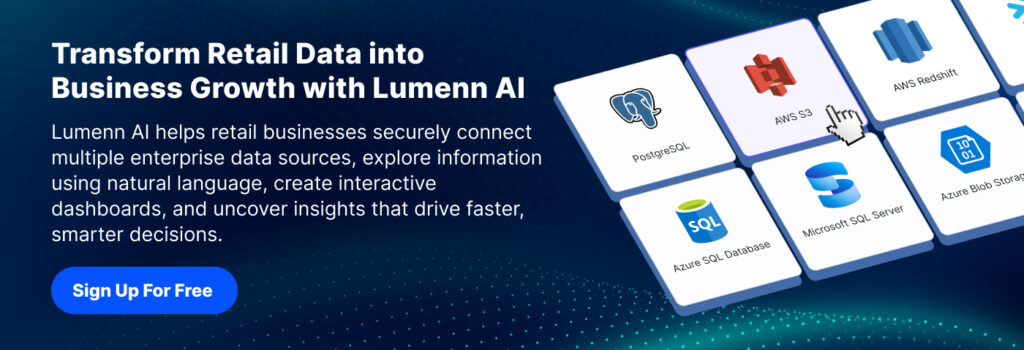
Retail businesses need analytics that keeps pace with changing customer expectations and growing data complexity. Lumenn AI brings together enterprise data from databases, cloud storage, and business systems into a single AI-powered analytics platform.
Instead of relying on technical teams or manually building reports, business users can simply ask questions in natural language and receive instant charts, dashboards, and actionable insights.
Whether you’re monitoring sales performance, understanding customer behavior, optimizing inventory, or evaluating marketing campaigns, Lumenn AI helps every team access trusted intelligence without writing code.
The platform also includes AI-powered Data Quality, Data Dictionary support, Auto Analyst for proactive recommendations, SQL Refinery for natural language SQL refinement, Chain of Thoughts for explainable AI, and self-service dashboards that automatically stay up to date with live enterprise data.
Five Questions Every Retail Leader Should Be Able to Answer
A connected analytics platform should help retailers answer questions like these within seconds.
- Which products generated the highest profit this month?
- Which stores need inventory replenishment first?
- Which customer segment has the highest lifetime value?
- What marketing campaign delivered the strongest return on investment?
- Which suppliers are causing shipment delays?
When answers become this accessible, organizations spend less time searching for information and more time making strategic decisions.
Preparing Retail for the Future
Retail analytics is moving beyond reports and dashboards.
The next generation of platforms combines artificial intelligence, live enterprise data, and conversational analytics to help businesses make decisions at the speed of change.
Organizations that embrace connected analytics today will be better positioned to respond to shifting customer expectations, optimize operations, and uncover opportunities before competitors do.
The future of retail belongs to businesses that see every piece of data as part of one connected story.