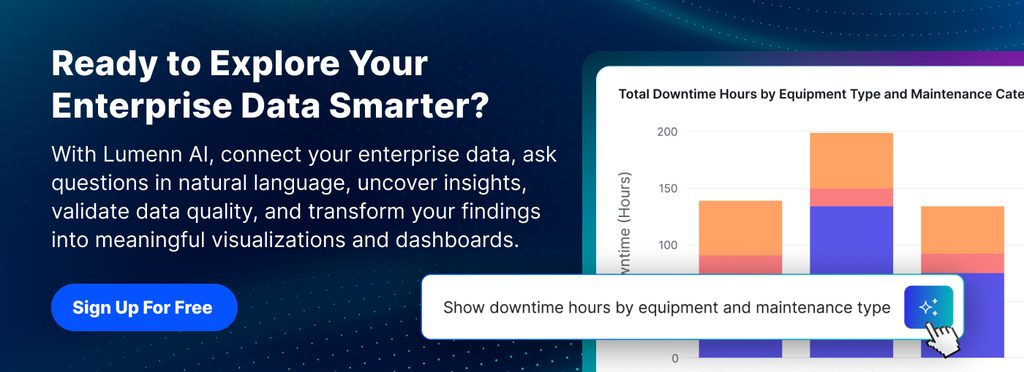

Every enterprise has data. Customer transactions, financial records, operational metrics, product usage, and business performance generate information every second.
Yet having access to data does not always mean having access to answers.
A business leader may want to understand why revenue changed. A product team may need to identify customer behavior patterns. An operations manager may want to investigate performance across locations. But when answering these questions requires technical expertise, complex queries, or multiple reporting requests, valuable insights can remain hidden.
This is where AI data analytics is changing how enterprises explore information.
By combining artificial intelligence, natural language processing, automated analysis, and data visualization, AI-powered analytics helps organizations interact with enterprise data more naturally, uncover patterns, and make informed decisions.
Instead of asking teams to navigate complicated analytical workflows, businesses can ask questions, explore results, and discover insights directly.
What Is AI Data Analytics?
AI data analytics is the use of artificial intelligence and machine learning technologies to analyze, interpret, and extract meaningful insights from data.
Traditional analytics often depends on predefined reports, dashboards, and manually written queries. AI-powered analytics introduces more flexible ways to explore information, understand trends, and investigate business questions.
Modern AI analytics platforms can help users:
- Query enterprise data using natural language.
- Identify trends and patterns.
- Generate charts and visualizations.
- Explore relationships between business metrics.
- Understand analytical results through explanations.
- Investigate questions without writing complex SQL.
In simple terms, AI data analytics helps enterprises turn business questions into meaningful insights with less technical effort.
Why Is AI Data Analytics Important for Enterprise Data Exploration?
Enterprise data is often distributed across databases, cloud warehouses, business applications, and operational systems.
Finding meaningful answers requires more than collecting information. Organizations need ways to explore that information efficiently.
AI-powered analytics helps address several common challenges.
1. Breaking Down Data Accessibility Barriers
Traditional analytics can require SQL knowledge, technical expertise, or assistance from data teams.
AI-powered natural language analytics allows business users to ask questions in everyday language.
For example:
“What are our top-performing products by revenue this quarter?”
Instead of manually constructing a query, users can describe what they want to understand and explore the resulting analysis.
This makes enterprise data more accessible to people across departments.
2. Exploring Data Beyond Predefined Dashboards
Dashboards are valuable for monitoring established KPIs, but business questions rarely remain the same.
A dashboard may show declining customer engagement. The next question could be:
“Which customer segments experienced the biggest decline?”
AI analytics helps users investigate these follow-up questions without starting a completely separate reporting process.
This creates a more flexible approach to enterprise data exploration.
3. Discovering Patterns Hidden in Large Datasets
Enterprise datasets can contain relationships that are difficult to identify through manual analysis alone.
AI-powered analytics can help users explore trends, compare segments, investigate anomalies, and identify patterns that deserve further attention.
For example, a sales team might discover that revenue growth differs significantly across regions, while an operations team may identify changes in performance across facilities.
These discoveries can help organizations understand what is happening and determine where deeper analysis is needed.
How AI Data Analytics Helps Explore Enterprise Data
Natural Language Querying Makes Data Exploration Easier
One of the most significant developments in AI analytics is the ability to interact with data using natural language.
Instead of writing SQL queries, users can ask questions such as:
“Show monthly revenue by region.”
They can then continue exploring:
“Compare it with the previous quarter.”
“Which region experienced the highest growth?”
This conversational approach makes analytics more intuitive and helps users investigate business questions without needing to understand query syntax.
AI-Powered Visualization Turns Data Into Understandable Insights
Numbers alone can make business performance difficult to interpret.
AI analytics platforms can transform queried data into visualizations such as bar charts, line graphs, tables, and other graphical representations.
For example, a finance team investigating revenue trends may use a line graph to understand changes over time.
A product team comparing feature adoption may use a bar chart to identify differences between customer segments.
Visualizations help users recognize patterns, compare performance, and communicate findings more effectively.
AI Helps Users Investigate Business Questions
Enterprise analytics becomes more valuable when users can move beyond the first answer.
Consider a business leader asking:
“What is our customer retention rate?”
The initial analysis provides a starting point.
The leader may then investigate:
“How does retention vary by customer segment?”
“Which segments experienced the biggest decline?”
“What has changed over the past six months?”
AI-powered analytics supports this iterative exploration, helping users move from broad questions toward more specific business insights.
Key Enterprise Use Cases for AI Data Analytics
AI data analytics creates opportunities across industries by helping organizations explore complex datasets, identify meaningful patterns, and make data-driven decisions. From patient outcomes to production efficiency, here is how different sectors can leverage AI to unlock enterprise data.
Healthcare: Turn Patient Data Into Better Operational Insights
Healthcare organizations generate extensive data across patient records, appointments, treatments, hospital operations, and clinical workflows. AI data analytics helps healthcare leaders explore patient demographics, appointment trends, treatment outcomes, and resource utilization. Teams can ask questions such as, “Which cities have the highest appointment demand?” or “How do treatment outcomes vary across patient groups?” These insights can support better resource planning, operational visibility, and informed healthcare decisions.
Life Sciences: Explore Research and Clinical Data Faster
Life sciences organizations work with complex datasets spanning clinical trials, laboratory research, drug development, quality control, and regulatory processes. AI-powered analytics helps research and operations teams explore these datasets, identify trends, and investigate variations across studies or production facilities. Questions such as “How do clinical trial outcomes vary by study location?” or “Which production batches show quality deviations?” can help teams gain visibility into critical research and operational metrics.
Banking: Strengthen Financial and Customer Intelligence
Banks manage vast amounts of data across transactions, customer accounts, loans, payments, and financial operations. AI data analytics helps banking teams investigate transaction patterns, understand customer behavior, monitor financial performance, and explore potential risk indicators. Teams can ask, “Which customer segments have experienced the highest growth in deposits?” or “How have loan approvals changed across regions?” These insights support more informed financial planning and customer-focused decisions.
Retail: Understand Customer Behavior and Sales Performance
Retail businesses need to continuously understand what customers buy, when demand changes, and which products drive revenue. AI analytics helps teams explore sales trends, inventory movement, customer preferences, regional performance, and product demand. Questions such as “Which products generate the highest revenue by region?” or “How does customer purchasing behavior change seasonally?” help retailers identify opportunities, improve inventory planning, and make smarter merchandising decisions.
Manufacturing: Improve Production and Operational Visibility
Manufacturing operations generate data across production lines, equipment, quality inspections, supply chains, and facility performance. AI data analytics helps manufacturers explore production efficiency, identify performance variations, monitor quality metrics, and investigate operational bottlenecks. Teams can ask, “Which production lines have the highest defect rates?” or “How does output vary across manufacturing facilities?” These insights can support process improvements, quality management, and more informed operational planning.
Energy: Explore Consumption, Production, and Performance Trends
Energy companies manage complex data across power generation, consumption, distribution, equipment, and infrastructure. AI-powered analytics helps teams investigate energy demand, compare production performance, identify consumption patterns, and explore operational changes. Questions such as “Which regions have experienced the highest increase in energy consumption?” or “How does power generation vary across facilities?” can provide valuable visibility for planning, resource management, and operational efficiency.
What Should Enterprises Look for in an AI Analytics Platform?
Choosing an AI analytics platform requires more than evaluating how quickly it generates charts.
Enterprises should consider capabilities that support reliable, scalable, and accessible data exploration.
Natural Language Analytics: Users should be able to ask questions without requiring advanced SQL knowledge.
Enterprise Data Connectivity: The platform should connect to relevant databases, warehouses, and storage systems.
Data Quality: Organizations need ways to identify missing values, duplicates, inconsistencies, and anomalies.
Business Context: Data dictionaries and business definitions help AI interpret enterprise terminology accurately.
Transparency: Users should be able to understand how analytical results were generated.
Security and Governance: Access controls, permissions, and appropriate governance practices should remain central to enterprise analytics.
These capabilities help organizations make AI analytics useful beyond individual experiments.
How Lumenn AI Helps Enterprises Explore Data With AI
Lumenn AI is an AI-powered, no-code enterprise analytics platform that helps organizations connect, query, validate, visualize, and understand their enterprise data using natural language.
Instead of requiring users to write SQL for every analytical question, Lumenn AI allows them to ask business questions and generate insights through conversational analytics.
Explore Enterprise Data Using Natural Language
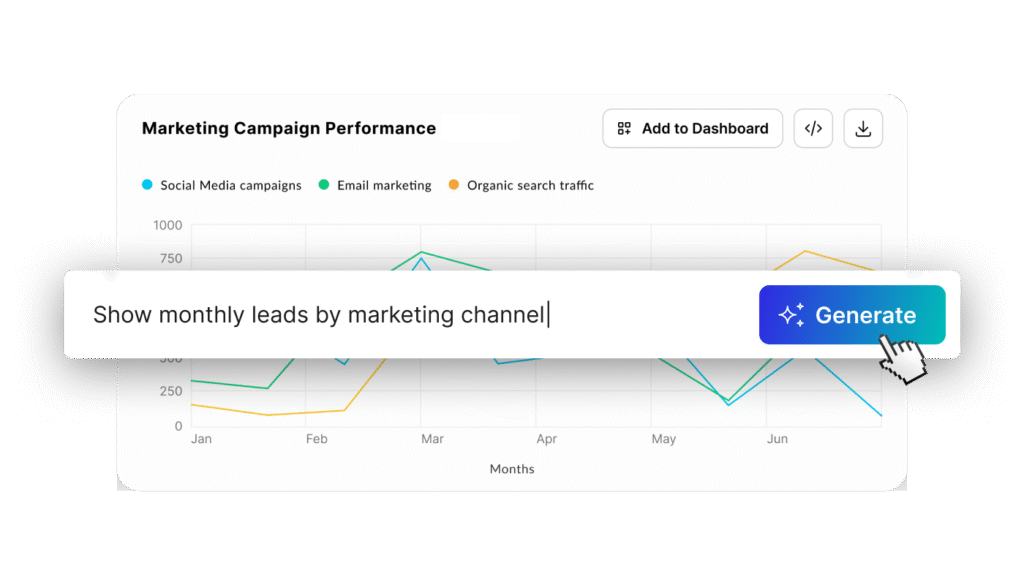
Business users can ask questions in plain English and generate analytical results without writing SQL.
This makes data exploration more accessible to teams across finance, product, operations, and leadership.
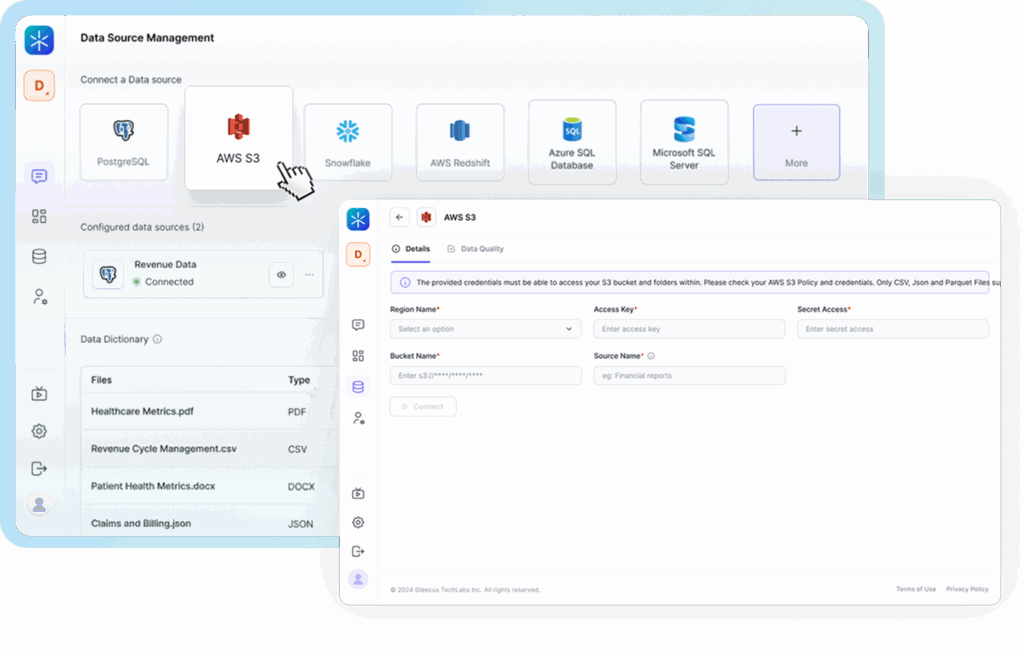
Connect Data Across Enterprise Systems
Lumenn AI supports connections to enterprise data sources, including PostgreSQL, MySQL, Snowflake, Amazon Redshift, Google BigQuery, Azure SQL, AWS S3, and Azure Blob Storage.
Its secure, in-place querying approach allows organizations to analyze connected data without copying or duplicating it into another analytics environment.
Generate Insights and Visualizations
Lumenn AI turns natural language questions into textual insights and visualizations.
Users can explore different chart types, investigate results, and add relevant visualizations to dashboards for ongoing monitoring and collaboration.

Improve Accuracy With Data Quality and Business Context
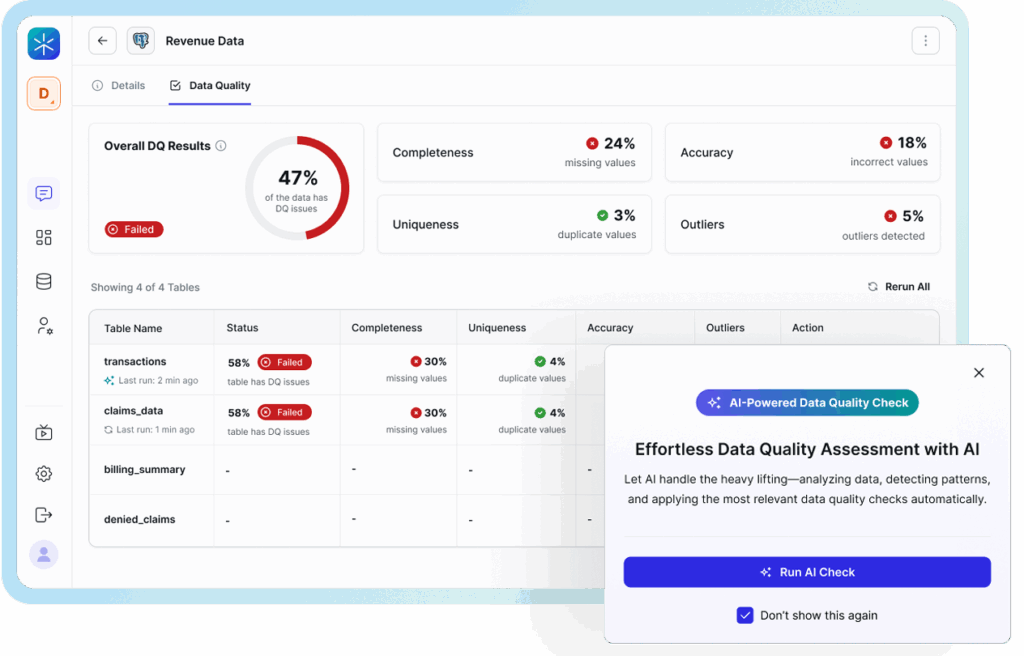
Lumenn AI includes Data Quality capabilities that help identify issues such as nulls, duplicates, inconsistencies, schema mismatches, and anomalies.
Organizations can also upload a Data Dictionary to provide business terminology, metric definitions, and field context.
Together, these capabilities help make enterprise data exploration more meaningful and consistent.
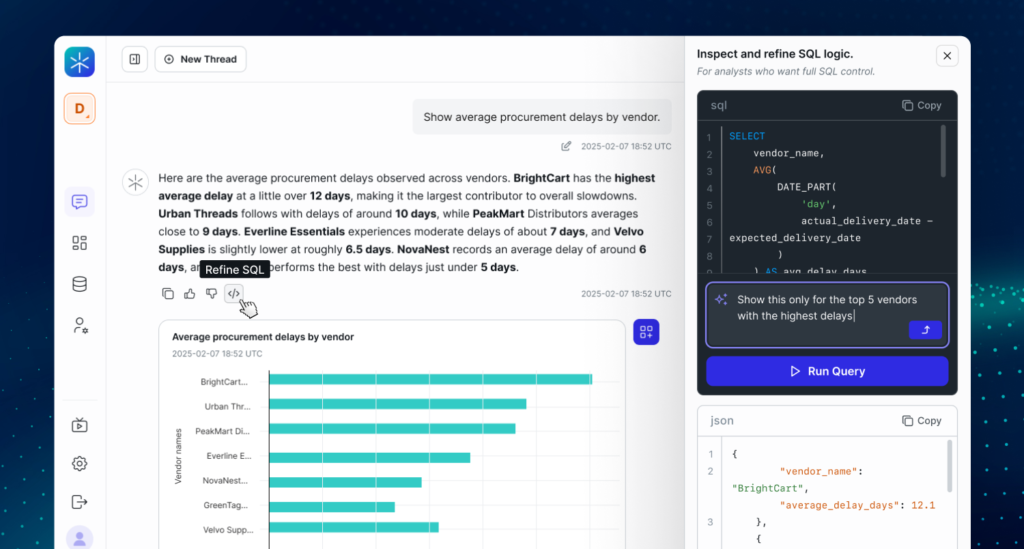
Refine AI-Generated Analysis With SQL Refinery
With SQL Refinery, users can view the SQL logic behind an AI-generated insight and describe changes using natural language.
They can refine filters, conditions, time ranges, and other query logic, then regenerate the insight.
This gives users greater control over how their analysis is produced.
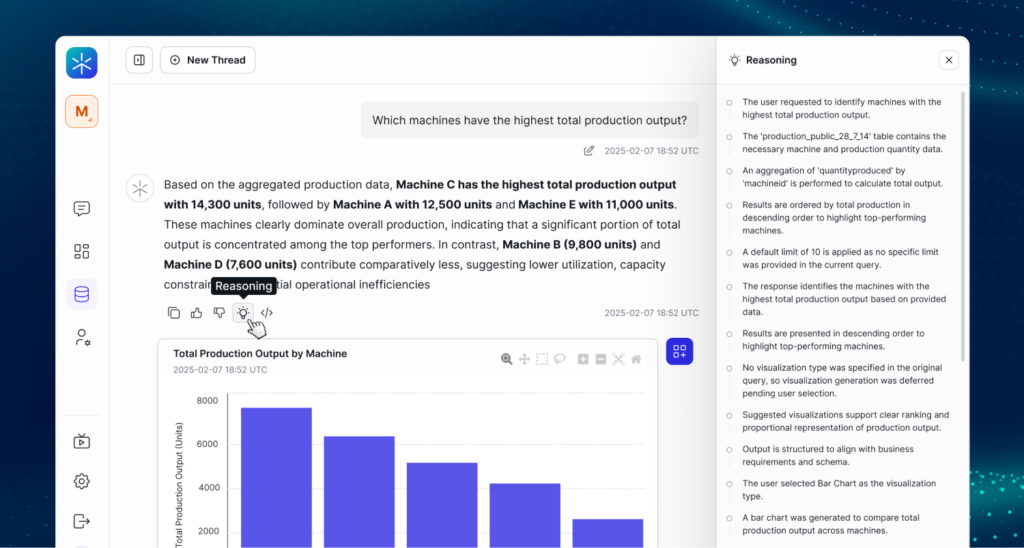
Understand Insights With Chain of Thoughts
Lumenn AI’s Chain of Thoughts feature provides a structured explanation of how an analytical question was interpreted, which data sources and logic were used, how SQL was generated, and how the resulting insight was derived.
This helps users understand the analytical process rather than treating AI-generated results as a black box.
With Lumenn AI, enterprises can bring natural-language analytics, data quality, business context, visualization, and transparency into one self-service analytics experience.
The Future of Enterprise Data Exploration
Enterprise analytics is moving beyond predefined reports and dashboards toward more flexible, conversational experiences.
AI data analytics makes it easier for users to ask questions, explore information, investigate patterns, and understand business performance.
But the real value comes when accessibility is supported by reliable data, business context, transparency, and governance.
Organizations that bring these capabilities together can make analytics more accessible across teams and create stronger connections between data exploration and business decisions.
The future is not simply about analyzing more data.
It is about helping more people discover what their data means.
Frequently Asked Questions
What is AI data analytics?
AI data analytics uses artificial intelligence to analyze data, identify patterns, generate insights, and support business decisions. It can simplify data exploration through natural language queries and automated visualizations.
How does AI help explore enterprise data?
AI helps users query enterprise data, investigate trends, compare business metrics, generate visualizations, and explore follow-up questions without relying entirely on manual analysis.
Can AI analytics be used without SQL?
Yes. AI-powered analytics platforms can translate natural language questions into analytical queries, allowing nontechnical users to explore data without writing SQL.
Is AI data analytics suitable for enterprise businesses?
Yes. Enterprise AI analytics can support sales, finance, operations, product, customer, and leadership teams, provided the platform meets the organization’s security, governance, data quality, and scalability requirements.
How does Lumenn AI help with enterprise analytics?
Lumenn AI enables users to connect enterprise data, ask questions in natural language, generate insights and visualizations, validate data quality, create dashboards, refine AI-generated SQL, and access structured explanations of analytical results.
Conclusion: Turn Enterprise Data Into Meaningful Insights
From healthcare and life sciences to banking, retail, manufacturing, and energy, every industry generates data that holds valuable business intelligence. But the real advantage comes from how effectively organizations can explore that information and turn it into meaningful action.
AI data analytics is making this possible by simplifying how teams interact with enterprise data. Natural language querying, automated visualizations, data quality checks, and transparent AI-generated insights are helping businesses move beyond traditional reporting and discover answers more independently.
The future of enterprise analytics is not just about collecting more data or building more dashboards. It is about making data accessible, understandable, and actionable for everyone involved in decision-making.