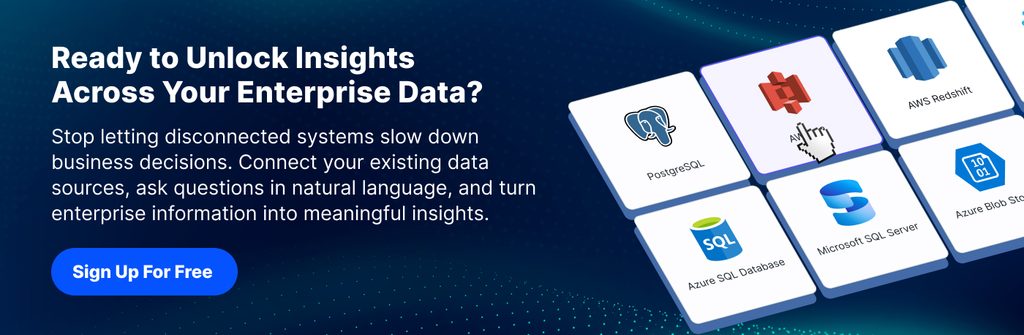

Imagine having customer information in one database, financial records in another, sales data in a CRM, and operational metrics stored in a cloud warehouse. Every system contains valuable information, but understanding the bigger business picture often means navigating multiple platforms.
For enterprise teams, this creates a familiar challenge: the data exists, but bringing it together for analysis takes time, technical effort, and sometimes expensive data migration projects.
But what if businesses could analyze data across multiple systems without moving it into a single location?
With modern enterprise analytics platforms, organizations can connect to existing data sources, query information, and generate insights while keeping their data within its existing environment.
This approach can simplify analytics, reduce unnecessary data movement, and help teams make decisions using information from across the enterprise.
Why Do Enterprises Struggle to Analyze Data Across Multiple Systems?
Modern enterprises rarely operate with a single data platform. They use a combination of databases, cloud warehouses, business applications, and storage systems to support different functions.
A finance team may use one platform, sales another, and operations a completely different system.
Although each system serves a purpose, fragmented data creates challenges:
- Disconnected information: Teams struggle to understand relationships between data stored across systems.
- Delayed reporting: Analysts may need to collect, transform, and combine data before producing reports.
- Migration complexity: Moving large datasets can require significant planning, infrastructure, and resources.
- Data duplication: Copying information across environments can create multiple versions of the same data.
- Limited accessibility: Nontechnical employees often depend on specialists to retrieve information from different systems.
The result? Business decisions can take longer because accessing insights becomes more complicated than asking the actual business question.
Can Enterprises Analyze Data Without Migrating It?
Yes. Enterprises can analyze data across multiple systems without migrating all their data into one centralized location by using approaches such as federated querying and direct data access.
These approaches allow analytics platforms to connect to existing data environments and retrieve information for analysis.
Depending on the platform and connector architecture, queries can be executed against the original data sources rather than requiring organizations to create a separate copy of every dataset.
For example, a business may have customer records in PostgreSQL, transaction information in MySQL, and historical sales data in Snowflake. An analytics platform with suitable connectivity can help users explore information across these environments without first requiring a full migration.
This gives organizations another way to make existing data useful while preserving their current infrastructure investments.
How Does Cross-System Analytics Work Without Data Migration?
Analyzing data across multiple systems typically involves a few important steps.
1. Connect Existing Data Sources
The first step is establishing secure connections to the databases, warehouses, and storage systems where enterprise information already resides.
Organizations can retain their existing data architecture while making relevant sources available to the analytics environment.
2. Access Relevant Data
Once connections are established, the analytics platform can retrieve the information required for a particular query. Depending on the architecture, this may involve direct querying, federated access, or other supported integration methods.
3. Explore Data Across Systems
Users can investigate information from different sources to understand business performance.
For example, an organization might want to compare customer acquisition data with transaction activity to understand which customer segments generate the most business.
4. Generate Insights and Visualizations
The platform can turn analytical results into charts, tables, and textual explanations, helping teams understand patterns without manually preparing every report.
5. Share and Monitor Results
Important findings can be organized into dashboards, shared with relevant teams, and refreshed according to supported schedules.
The result is a more connected analytics experience without making full data migration a prerequisite.
5 Benefits of Analyzing Enterprise Data Without Migration
1. Preserve Existing Data Infrastructure
Organizations have already invested in databases, cloud platforms, and enterprise applications. An analytics approach that connects to existing systems helps them build on those investments instead of immediately replacing or consolidating them.
2. Reduce Data Movement and Duplication
Avoiding unnecessary copies can simplify data management and reduce the operational overhead associated with maintaining duplicate datasets.
3. Access Insights Faster
When users can query connected data sources directly, teams may be able to reduce the preparation steps involved in traditional reporting workflows.
4. Support Better Cross-Department Decisions
Sales, finance, operations, and product teams can explore information from relevant systems to develop a more complete understanding of business performance.
5. Maintain Greater Control Over Data
Keeping information within existing environments can support an organization’s data management strategy. However, secure connectivity, permissions, encryption, and governance must still be evaluated and implemented appropriately.
What Should Enterprises Look for in a No-Migration Analytics Platform?
Not every analytics platform offers the same integration capabilities. Enterprises should evaluate several important considerations before choosing a solution.
- Broad data connectivity: Support for the databases, warehouses, and storage systems already used by the organization.
- Secure access: Appropriate authentication, permissions, encryption, and access controls.
- Query flexibility: The ability to retrieve and analyze relevant information from connected sources.
- Natural language analytics: Business users should be able to ask questions without requiring advanced SQL skills.
- Data quality: Capabilities to identify missing values, duplicates, inconsistencies, and anomalies.
- Visualization and dashboards: The ability to convert analytical results into understandable and shareable insights.
- Transparency: Users should be able to understand and validate how AI-generated results are produced.
A strong platform should make existing enterprise data easier to explore without adding unnecessary complexity to the technology environment.
How AI Is Simplifying Analytics Across Multiple Systems
Connecting data sources is only one part of the challenge. Making that information accessible to everyday business users is equally important.
AI-powered analytics is changing how employees interact with enterprise data.
Traditionally, users needed to understand database structures, write SQL queries, and configure reports. With natural language analytics, they can ask questions in everyday business language.
For example:
“Compare monthly revenue with customer acquisition across regions.”
Instead of manually navigating multiple reports, users can explore the requested analysis through a conversational interface, subject to the platform’s supported data connections and query capabilities.
They can ask follow-up questions, investigate trends, and generate visualizations without starting the reporting process from scratch.
This makes cross-system analytics more accessible to business users while allowing data teams to focus on more complex requirements.
How Lumenn AI Helps Enterprises Analyze Data Without Migration
Lumenn AI is an AI-powered, no-code enterprise analytics platform that helps organizations connect, query, validate, visualize, and understand their data using natural language.
Rather than requiring users to navigate multiple technical workflows, Lumenn AI provides a conversational way to explore connected enterprise data.
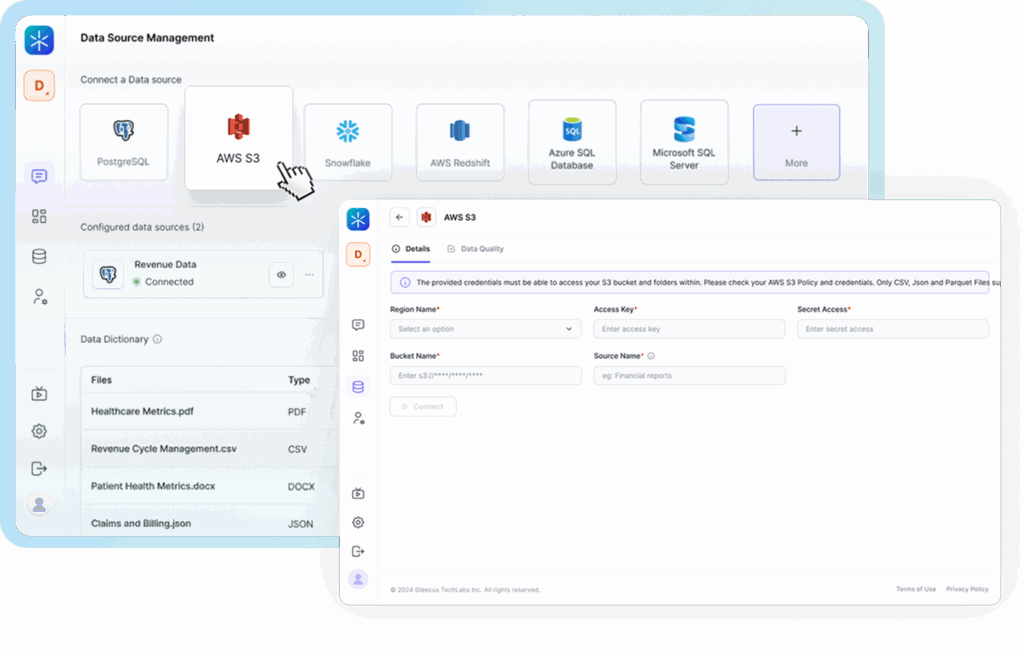
Connect Your Existing Enterprise Data Sources
Lumenn AI supports connections to PostgreSQL, MySQL, Snowflake, Amazon Redshift, Google BigQuery, Azure SQL, AWS S3, and Azure Blob Storage.
This helps organizations access data across their existing technology environment without making full data migration a prerequisite for analytics.
Ask Questions Without Writing SQL
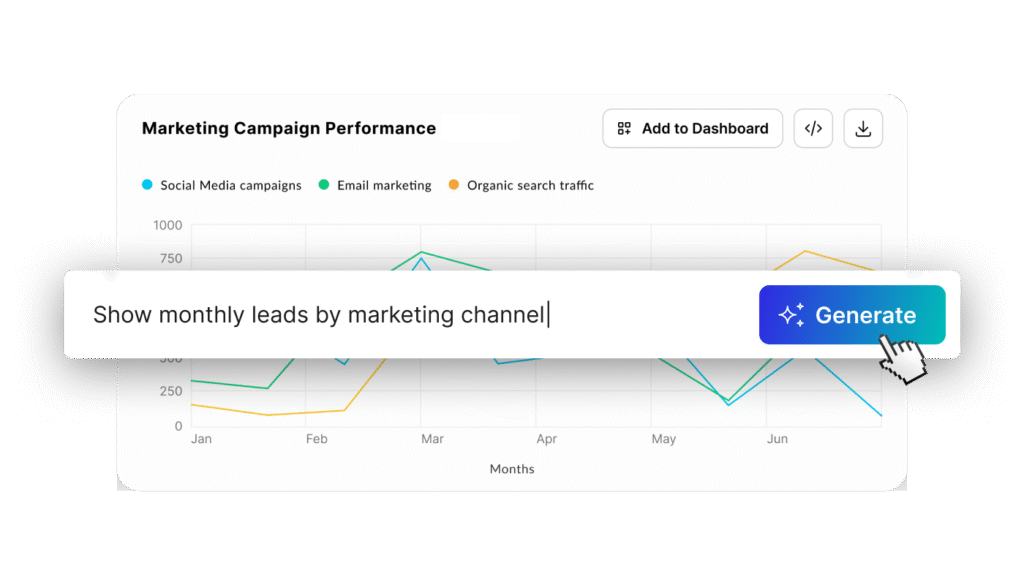
Users can ask business questions in natural language and generate insights, textual explanations, and visualizations without needing to write SQL manually.
Validate Data Quality
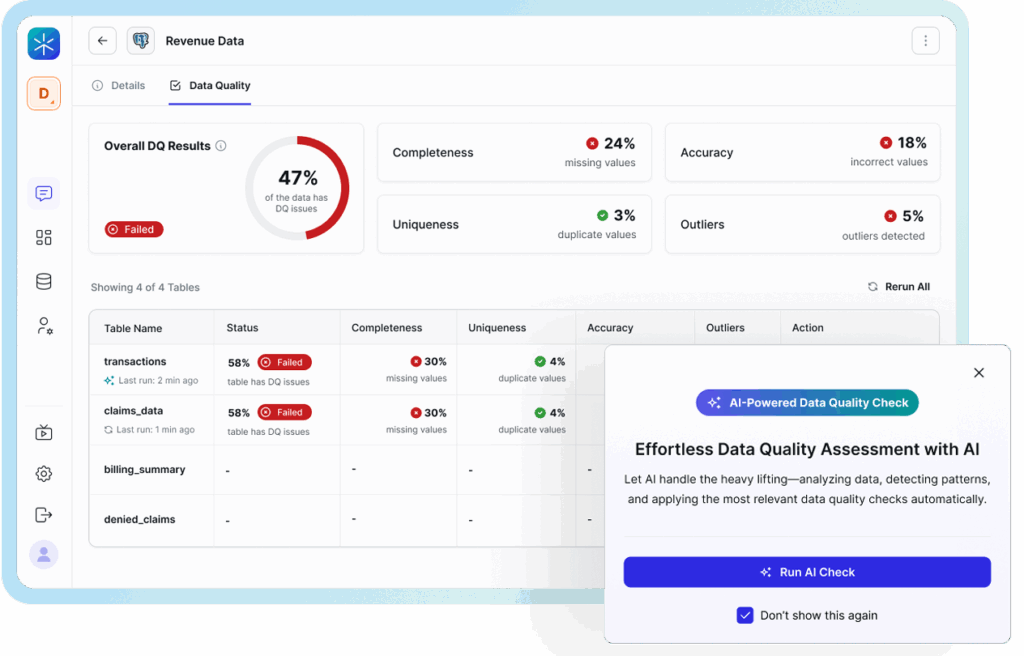
Lumenn AI’s Data Quality capabilities help identify nulls, duplicates, inconsistencies, schema mismatches, and anomalies, supporting more reliable analysis.
Build Dashboards From Insights
Users can pin generated visualizations to dashboards, share findings with teams, and configure automatic refresh intervals to keep dashboards updated based on source data.

Refine AI-Generated SQL With Natural Language
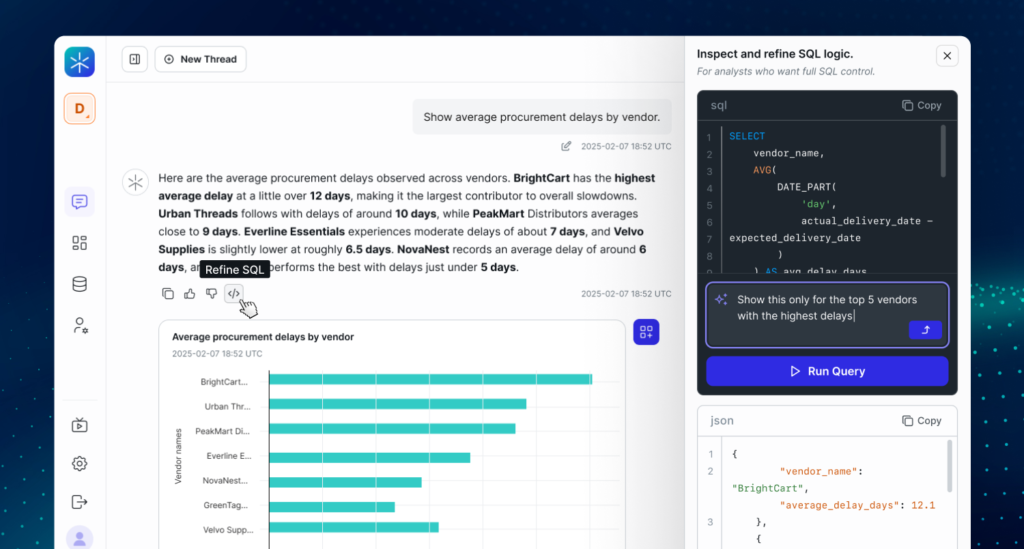
With SQL Refinery, users can view the SQL logic behind an AI-generated insight, describe the changes they want in natural language, and regenerate the result. This gives teams more control over their analysis without requiring them to manually rewrite SQL.
Understand How Insights Are Generated
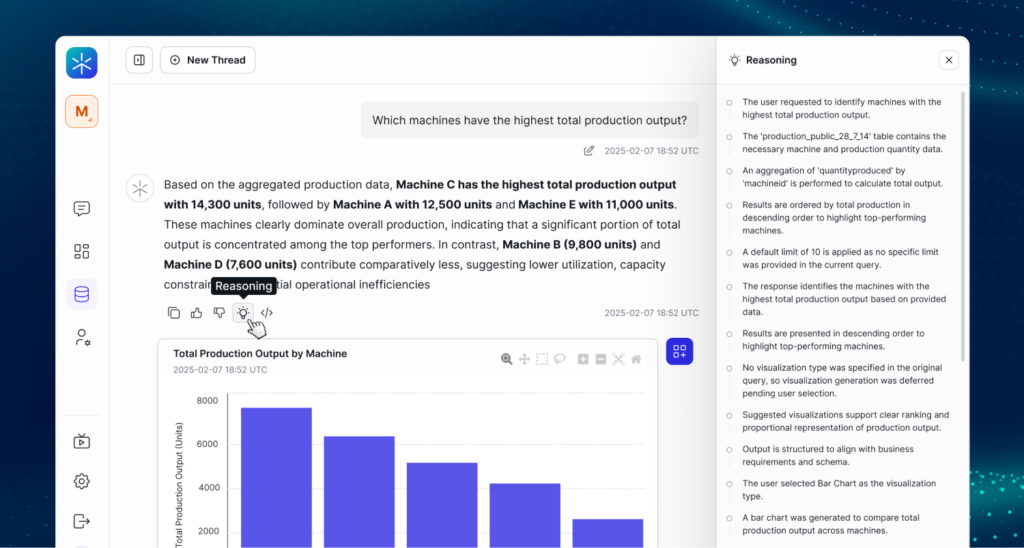
Chain of Thoughts provides a structured explanation of how a question was interpreted, which data sources and logic were used, how SQL was generated, and how the resulting insight was produced.
By bringing enterprise connectivity, conversational analytics, data quality, dashboards, and transparency together, Lumenn AI helps organizations make better use of their existing data environment.
Frequently Asked Questions
1. Can enterprises analyze data from multiple databases without migration?
Yes. Platforms supporting direct data access or federated querying can retrieve and analyze information from connected databases without requiring full data migration.
2. What is federated querying?
Federated querying allows users to query data across multiple sources through a unified interface without necessarily consolidating all the underlying data into one location.
3. Is analyzing data without migration secure?
It can be secure when supported by appropriate authentication, access permissions, encryption, network controls, and enterprise governance policies.
4. Does no-migration analytics eliminate data duplication?
It can reduce the need for unnecessary data copies, although some architectures may still use caching, temporary processing, or materialized results.
5. Can AI analyze data across multiple enterprise systems?
Yes, AI-powered analytics platforms can help users explore connected data sources using natural language, provided the platform supports the required connectors and cross-source query operations.
6. How does Lumenn AI support analytics across multiple systems?
Lumenn AI connects to supported enterprise databases, warehouses, and storage platforms, allowing users to ask natural-language questions, generate visualizations, validate data quality, and build dashboards.
Conclusion: Make Your Existing Data Work Together
Enterprise data does not need to live in one place to deliver a connected business perspective.
Organizations can build a more accessible analytics environment by connecting existing systems, reducing unnecessary data movement, and enabling teams to explore information through modern analytics platforms.
For CIOs, CTOs, and data leaders, this means an opportunity to simplify analytics without automatically taking on the complexity of a large-scale migration project.
The next step in enterprise analytics is not necessarily moving all your data. It is making the data you already have easier to access, understand, and act upon.