
Imagine you’re in a business meeting. Someone asks an AI analytics tool a question. Within seconds, a polished chart appears, accompanied by a confident explanation. The numbers look convincing, and the insight seems useful.
Then someone asks a simple question:
“How did the AI arrive at this conclusion?”
Suddenly, the conversation changes.
In today’s data-driven enterprises, getting answers quickly is no longer enough. Business leaders need to understand where those answers came from, what data was used, and whether the underlying logic makes sense.
As AI becomes increasingly integrated into business intelligence and analytics, one question deserves more attention: Can organizations truly trust AI-generated insights if they cannot understand how those insights were produced?
Why Trust Matters in AI-Powered Analytics
AI is changing how organizations interact with enterprise data. Employees can ask questions in natural language, generate visualizations, and explore business trends without writing complex SQL queries.
This makes analytics more accessible. However, accessibility alone does not guarantee reliability.
An AI-generated answer can be influenced by several factors:
- The quality and completeness of the underlying data.
- How the user’s question is interpreted.
- Which data sources and fields are selected.
- The filters, calculations, and logic applied.
- How the results are presented and interpreted.
If any of these elements are misunderstood or incorrect, the final insight may be misleading.
For example, a report showing declining customer activity might appear straightforward. But was the correct customer segment selected? Was the time period interpreted properly? Were inactive and new customers treated consistently?
Without visibility into the analytical process, users may find it difficult to evaluate the result.
Trustworthy AI analytics requires more than accurate-looking answers. It requires transparency, validation, and accountability.
What Makes an AI-Generated Insight Trustworthy?
Trust should not depend on how confidently an AI system presents its answer. It should depend on whether the result can be examined and validated.
1. Clear Data Sources
Users should know which datasets or sources contributed to an insight. When information comes from multiple enterprise systems, understanding its origin becomes especially important.
2. Transparent Analytical Logic
The system should make it possible to understand how a question was interpreted, which filters were applied, and what calculations shaped the result.
3. Reliable Data Quality
Missing values, duplicate records, inconsistent formats, and anomalies can affect analytical outcomes. Data quality checks help identify issues that users should consider before acting on an insight.
4. Human Control
AI should accelerate analysis without removing the user’s ability to question, refine, or validate the result. Business users and analysts should be able to investigate the logic rather than accept every output automatically.
5. Governance and Accountability
Enterprise analytics must operate within appropriate access permissions, security policies, and audit practices. Not every employee should have unrestricted access to every dataset.
Together, these elements create a stronger foundation for responsible AI-powered decision-making.
The Risks of Treating AI Answers as Facts
The convenience of conversational analytics can sometimes encourage users to accept answers too quickly. This creates risks that enterprises should actively manage.
Misinterpreted questions: A broad or ambiguous prompt may produce an answer that does not reflect the user’s actual intention.
Inaccurate or incomplete data: Even well-designed analytical logic cannot compensate for missing or inconsistent source information.
Lack of explainability: When users cannot understand how a result was generated, validating it becomes more difficult.
Overdependence on automation: Treating AI outputs as final decisions can discourage critical thinking and independent verification.
Inconsistent business definitions: Different departments may interpret terms such as revenue, active customer, or customer churn differently, leading to conflicting results.
The solution is not to avoid AI analytics. It is to adopt it with the right balance of automation, transparency, and human oversight.
Explainable AI: Moving Beyond the Black Box
Explainable AI (XAI) focuses on making AI outputs more understandable to the people using them.
In enterprise analytics, this means giving users meaningful visibility into the process behind an insight.
Consider a business question:
“Which regions experienced the highest decline in sales this quarter?”
A conventional analytics experience may provide a chart showing the regions and their sales performance.
An explainable analytics experience should also help users understand:
- How the question was interpreted.
- Which data sources were used.
- What date ranges and filters were applied.
- How the analytical query was constructed.
- How the final result and visualization were derived.
This additional context helps users examine the answer rather than simply consume it.
Explainability is particularly valuable when analytics supports financial planning, operational reviews, customer strategy, and other important business decisions.
Why Data Quality Is the Foundation of Trust
There is a simple principle in analytics: An insight is only as dependable as the data supporting it.
AI can process information quickly, but it cannot automatically make every source dataset complete, consistent, or accurate.
For example, duplicate transaction records could distort transaction volume. Missing customer information could affect segmentation. Inconsistent date formats could create problems when comparing reporting periods.
This is why data quality should be part of the analytics workflow.
Organizations should monitor key dimensions such as:
- Completeness: Are required values present?
- Uniqueness: Are duplicate records affecting results?
- Accuracy: Does the information correctly represent the intended data?
- Consistency: Are formats and definitions aligned?
- Anomaly detection: Are there unusual values or patterns that require investigation?
When users can identify potential data issues before relying on an insight, they are better equipped to make informed decisions.
How Lumenn AI Makes AI-Powered Analytics More Transparent
Getting an answer from AI is useful. Understanding, validating, and refining that answer is what makes it more valuable in an enterprise environment.
Lumenn AI is an AI-powered, no-code enterprise analytics platform that helps organizations connect, query, validate, and visualize data using natural language.
With capabilities designed around transparency and user control, Lumenn AI helps teams move beyond simply generating insights.
Chain of Thoughts: Understand How Insights Are Generated
Lumenn AI’s Chain of Thoughts feature provides a structured explanation of the analytical process behind an insight.
Users can understand how their question was interpreted, which data sources were used, what filters and logic were applied, how SQL was generated, and how the final visualization was derived.
This gives business users greater visibility into the process behind AI-generated results and makes it easier to examine the analytical approach.
SQL Refinery: Refine the Logic Behind an Insight
Sometimes the initial answer is useful, but the analysis needs adjustment.
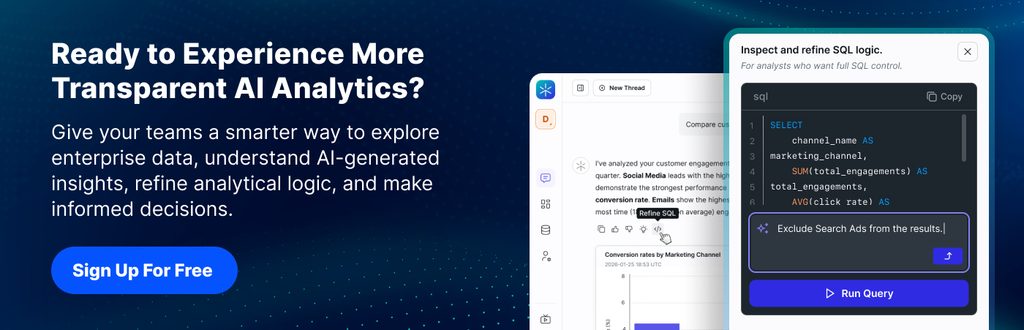
With SQL Refinery, users can view the SQL behind an AI-generated insight and describe changes using natural language.
They can request adjustments to filters, time ranges, conditions, limits, or joins, then regenerate the insight to see the updated result.
This brings human direction into AI-powered analytics without requiring users to manually rewrite SQL.
Data Quality: Build Confidence in the Underlying Data
Lumenn AI’s Data Quality capabilities help identify issues such as null values, duplicates, inconsistencies, schema mismatches, and anomalies.
By bringing data quality checks into the analytics experience, teams can better understand potential problems in their source data before relying on the resulting insights.
Together, Chain of Thoughts, SQL Refinery, and Data Quality support a more transparent and controlled approach to enterprise analytics.
The objective is simple: make AI-generated insights easier to understand, investigate, and refine.
How Enterprises Can Build Trust in AI Analytics
Adopting trustworthy AI analytics requires more than selecting a platform. Organizations should establish practices that make responsible usage part of everyday work.
- Start with trusted data: Identify important data sources and establish quality checks.
- Define business terminology: Maintain consistent definitions for metrics, dimensions, and key business terms.
- Make analytical processes visible: Encourage users to examine sources, filters, and logic behind important results.
- Keep humans involved: Treat AI as an analytical assistant, not an unquestionable decision-maker.
- Establish governance: Apply appropriate access controls, monitoring, and accountability.
- Educate business users: Help employees understand how to question, validate, and interpret AI-generated insights.
These practices help organizations make AI analytics more useful without sacrificing oversight.
Frequently Asked Questions About Trustworthy AI Analytics
Can AI-generated insights be trusted?
They can support business decisions when backed by reliable data, appropriate analytical logic, transparency, and human validation. AI outputs should not automatically be treated as facts.
What is explainable AI in analytics?
Explainable AI makes the process behind AI-generated results more understandable, including how inputs are interpreted and how outputs are produced.
Why is data quality important for AI analytics?
Missing, duplicated, or inconsistent data can affect analytical results. Data quality checks help identify these issues and improve confidence in insights.
How can businesses validate AI-generated insights?
Businesses can examine data sources, filters, calculations, SQL logic, and underlying data quality before using insights to guide decisions.
How does Lumenn AI support transparent analytics?
Lumenn AI offers Chain of Thoughts for structured explanations, SQL Refinery for natural-language query refinement, and Data Quality capabilities to identify potential issues in source data.
Conclusion: Don’t Just Trust the Answer. Understand It.
AI has made it easier than ever to turn business questions into analytical insights. But as enterprises rely more heavily on AI-powered analytics, the ability to understand and validate those insights becomes just as important as the speed of generating them.
The future of enterprise analytics will not be defined by how quickly AI can produce an answer. It will be defined by how confidently people can understand, question, and act on that answer.
Because in business, an answer is only valuable when you have a reason to trust it.