
Healthcare organizations generate massive volumes of data every day, from electronic health records (EHRs) and lab systems to imaging platforms, operational systems, and patient monitoring devices. The challenge is no longer data availability. The real challenge is turning that data into timely, actionable clinical insights that improve patient outcomes and operational efficiency.
Artificial Intelligence is accelerating this shift by helping healthcare teams analyze complex datasets faster, detect hidden patterns, and support evidence-based decision-making. Modern AI-driven analytics platforms enable clinicians and healthcare administrators to move from reactive reporting to proactive, insight-driven care delivery.
Studies show AI-powered clinical decision support systems can improve diagnostic accuracy by analyzing patient records, symptoms, and lab results in real time, reducing diagnostic gaps and enabling faster clinical decisions.
Why Healthcare Needs Faster Clinical Insights
Healthcare data exists across multiple systems, formats, and departments. When insights take too long to generate, patient care and operational efficiency suffer.
Common challenges include:
- Fragmented patient data across systems
- Manual reporting delays
- Limited real-time visibility into patient trends
- Difficulty identifying early risk signals
- High dependency on technical or analytics teams
AI analytics changes this by enabling continuous data analysis and real-time insight delivery. AI-driven systems can cross-reference symptoms and medical data across thousands of conditions, helping reduce misdiagnosis rates and improving care quality.
How AI Turns Healthcare Data into Clinical Insights
1. Real-Time Data Analysis
AI can process large volumes of clinical data simultaneously, including structured and unstructured information. This enables clinicians to see patient risk signals earlier and make faster treatment decisions.
AI-powered systems can detect subtle patterns and predict deterioration earlier, enabling quicker intervention and improving patient outcomes.
2. Improved Diagnostic Accuracy
AI models analyze patient history, lab results, and symptoms together. This reduces missed diagnoses and ensures all relevant clinical information is considered.
Research indicates AI-assisted clinical systems can improve diagnostic accuracy by 20–30% in certain conditions by analyzing medical data more comprehensively.
3. Predictive Clinical Intelligence
AI enables predictive analytics that helps identify high-risk patients earlier.
Examples include:
- Early detection of disease progression
- Predicting patient deterioration
- Identifying readmission risks
- Forecasting patient demand and capacity
Predictive analytics can improve early detection of critical conditions by up to 25%, enabling proactive care instead of reactive treatment.
The Role of Enterprise Analytics in Healthcare
Healthcare organizations are increasingly adopting enterprise analytics to unify clinical, operational, and financial data.
Enterprise AI analytics enables:
- Cross-department clinical visibility
- Faster reporting cycles
- Standardized clinical decision support
- Better resource planning
- Data-driven patient care pathways
Seamless data flow across healthcare systems is critical, with most providers recognizing interoperability as essential to maximize analytics value.
How Lumenn AI Helps Healthcare Teams
Lumenn AI enables healthcare teams to turn complex healthcare data into fast, reliable clinical insights using AI-powered enterprise analytics.
Natural Language Healthcare Analytics
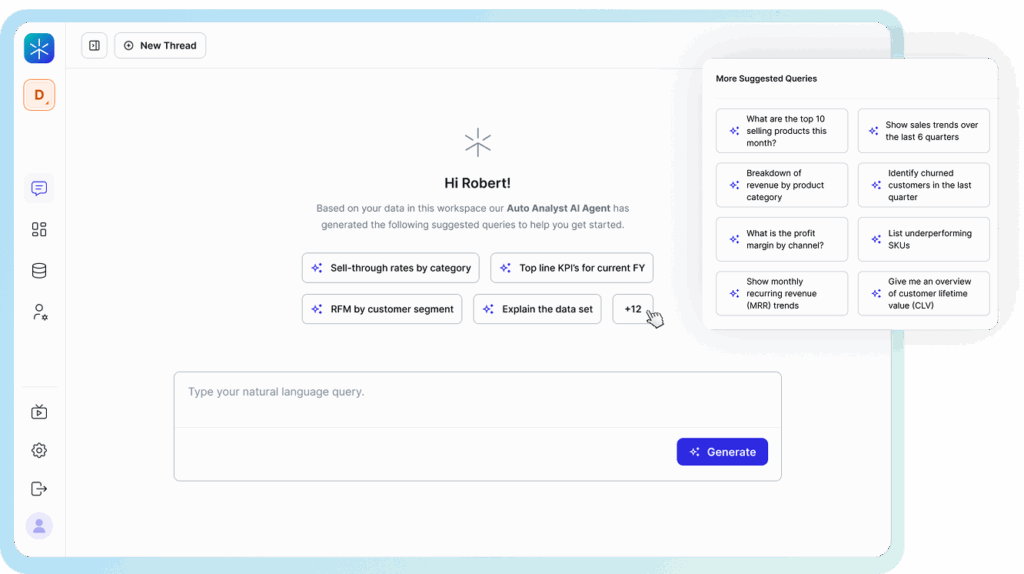
Healthcare teams can ask questions in plain English such as:
- “Which patient groups show high readmission risk?”
- “Show ICU occupancy trends over the last 30 days.”
Lumenn AI instantly generates visualizations, tables, and insights—helping clinicians and administrators make faster decisions.

No-Code Clinical Dashboards
Healthcare teams can create real-time dashboards without technical expertise.
Dashboards can track:
- Patient outcomes
- Department performance
- Resource utilization
- Clinical KPIs
Dashboards update automatically as source data updates, ensuring decision-makers always see the latest information.

AI Auto Analyst for Proactive Healthcare Insights
Lumenn AI’s Auto Analyst automatically scans healthcare datasets and suggests meaningful clinical questions.
This helps teams:
- Discover insights faster
- Reduce manual exploration time
- Identify hidden clinical trends
In-Place Healthcare Data Analytics
Lumenn AI queries healthcare data where it already exists, without moving sensitive patient data.
This helps maintain:
- Data privacy
- Regulatory compliance
- Infrastructure stability

Enterprise-Grade Security for Healthcare
Lumenn AI supports enterprise security needs with:
- Role-based access control
- Encryption
- Audit logging
This ensures sensitive patient and operational data remains protected.

Real-World Impact of AI Clinical Insights
Healthcare organizations using AI analytics are seeing measurable improvements:
- Faster diagnosis and treatment planning
- Reduced clinical errors
- Improved patient safety
- Better care standardization
- Lower operational costs
AI-powered alerts can prevent medication errors and detect harmful drug interactions earlier, improving overall patient safety and outcomes.
The Future of Healthcare is Insight-Driven
Healthcare is moving toward predictive, personalized, and proactive care models.
AI analytics will continue enabling:
- Precision medicine
- Early disease detection
- Real-time clinical monitoring
- Intelligent hospital operations
Organizations that adopt AI-driven analytics early will be better positioned to deliver high-quality patient care while improving operational efficiency.
Conclusion
Turning healthcare data into faster clinical insights is no longer optional—it is essential.
AI-powered analytics enables healthcare organizations to move from data overload to clinical intelligence. By enabling real-time analysis, predictive insights, and accessible analytics for all teams, healthcare providers can deliver better patient outcomes while optimizing operations.
Lumenn AI helps healthcare teams unlock the full value of their data—without complexity, coding, or delays.