
The life sciences industry is evolving at an unprecedented pace. From clinical research and drug development to manufacturing and regulatory compliance, organizations generate massive volumes of data every day. Yet, turning that data into meaningful insights often remains a slow and complex process.
Scientists, researchers, quality teams, and business leaders frequently depend on data analysts to build reports or write SQL queries before they can answer even the simplest business questions. These delays can impact research timelines, operational efficiency, and strategic decision-making.
This is where Conversational Analytics is changing the landscape.
Instead of navigating complex dashboards or waiting for reports, life sciences teams can simply ask questions in natural language and receive accurate insights within seconds. By making enterprise data accessible to everyone, conversational analytics empowers organizations to make faster, more informed decisions while maintaining security and governance.
Why Data Complexity Is Growing in Life Sciences
Life sciences organizations manage data from multiple systems, including:
- Clinical trial databases
- Laboratory Information Management Systems (LIMS)
- Manufacturing systems
- Quality management platforms
- ERP and supply chain systems
- Regulatory and compliance databases
- Customer and commercial platforms
Each system provides valuable information, but when data remains disconnected, it becomes difficult to gain a complete picture of operations.
Without unified analytics, organizations often face:
- Delayed reporting cycles
- Limited visibility across departments
- Manual data preparation
- Inconsistent metrics
- Slower regulatory responses
- Increased dependency on technical teams
Modern organizations need a smarter way to explore enterprise data.
What Is Conversational Analytics?
Conversational Analytics allows users to interact with enterprise data using simple, natural language instead of SQL queries or complex BI tools.
For example, instead of creating multiple filters and reports, a researcher can simply ask:
“Which clinical trial sites reported the highest patient enrollment this quarter?”
Within seconds, the platform generates:
- Interactive visualizations
- Data tables
- Text based summaries
- Actionable insights
The experience feels as natural as having a conversation with your data.
Why Conversational Analytics Matters for Life Sciences
Faster Research Decisions
Clinical research generates enormous amounts of structured and unstructured data.
Conversational analytics enables research teams to quickly identify enrollment trends, monitor trial progress, compare outcomes, and detect patterns without waiting for scheduled reports.
Faster access to information accelerates research timelines and supports better scientific decisions.
Better Manufacturing Visibility
Manufacturing facilities constantly monitor production quality, equipment performance, and batch consistency.
Instead of reviewing multiple reports, operations teams can ask questions like:
“Which production line reported the highest deviation rate this month?”
Instant insights allow teams to identify issues early and improve production efficiency.
Improved Regulatory Compliance
Regulatory compliance depends on accurate, traceable data.
Conversational analytics makes it easier to retrieve quality metrics, investigate deviations, and monitor compliance indicators without manually searching across multiple systems.
This improves audit readiness while reducing administrative effort.
Stronger Collaboration Across Teams
Scientists, quality managers, manufacturing teams, and executives often rely on different reporting tools.
Conversational analytics creates a common interface where every stakeholder can access trusted information using simple language.
This improves communication and enables faster cross-functional decision making.
Common Use Cases in Life Sciences
Clinical Trial Performance
Track enrollment, patient retention, site performance, and trial progress through interactive analytics.
Example Questions:
- Which trial sites exceeded enrollment targets?
- What is the patient dropout trend over the last six months?
- Compare enrollment across regions.
Manufacturing Quality
Monitor production quality across facilities and identify issues before they affect downstream processes.
Example Questions:
- Which batches failed quality inspection?
- Show manufacturing deviations by facility.
- Which production line has the highest defect rate?
Supply Chain Analytics
Gain visibility into inventory, supplier performance, and distribution activities.
Example Questions:
- Which raw materials have the highest procurement delays?
- Show inventory levels across manufacturing plants.
- Which suppliers consistently deliver on time?
Regulatory Reporting
Quickly explore quality records, compliance metrics, and audit information.
Example Questions:
- Show unresolved CAPA records.
- Which facilities reported the highest compliance deviations?
- Display monthly audit findings.
Key Benefits of Conversational Analytics
Organizations adopting conversational analytics experience several business advantages:
Increased Productivity
- Reduce manual reporting
- Eliminate repetitive SQL requests
- Accelerate access to enterprise data
Better Decision Making
- Real-time visibility
- Interactive visualizations
- Faster identification of trends
Greater Accessibility
- No coding knowledge required
- Business users become self-sufficient
- Faster collaboration across departments
Improved Data Confidence
- Consistent business definitions
- Better data governance
- More reliable analytics
How Lumenn AI Simplifies Analytics for Life Sciences
Life sciences organizations require analytics platforms that are not only powerful but also secure, scalable, and easy to use. Lumenn AI is built to meet these evolving needs by transforming complex enterprise data into actionable insights through conversational analytics.
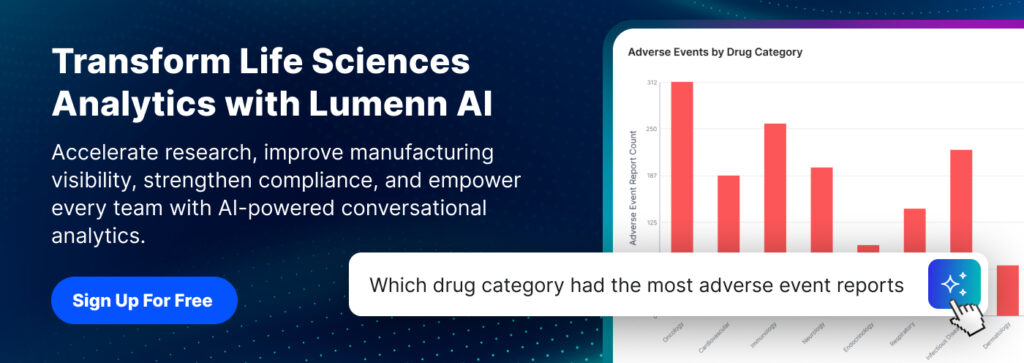
With Lumenn AI, research teams, manufacturing leaders, quality managers, and business users can simply ask questions in plain English and receive AI-generated charts, tables, and summaries in seconds. There is no need to write SQL or rely on technical teams for every report.
Lumenn AI helps life sciences organizations by providing:
- Natural Language Business Queries that make enterprise data accessible to everyone.
- Self-Service Dashboards for tracking clinical, operational, manufacturing, and compliance KPIs.
- Multi-Source Data Integration to securely connect databases and cloud storage without moving data.
- AI-Powered Data Quality that identifies inconsistencies, duplicates, null values, and anomalies before analysis.
- Data Dictionary support that gives AI the business context needed to deliver more accurate and meaningful insights.
- AI Auto Analyst that proactively recommends questions and surfaces important trends for faster exploration.
- Enterprise-Grade Security with role-based access, encryption, and audit logs to support governance and compliance.
- Chain of Thoughts that provides transparent reasoning behind AI-generated insights, building confidence in every decision.
Whether you’re monitoring clinical trials, analyzing manufacturing performance, reviewing regulatory metrics, or optimizing supply chains, Lumenn AI enables every team to explore enterprise data confidently and make decisions faster.

The Future of Life Sciences Analytics
The future of life sciences will be driven by organizations that can transform growing volumes of enterprise data into timely, actionable intelligence.
Conversational analytics is no longer just a productivity tool. It is becoming the foundation for faster research, smarter manufacturing, stronger compliance, and more collaborative decision-making.
Organizations that remove technical barriers and empower every employee to interact with data will gain a significant competitive advantage.
As AI continues to evolve, conversational analytics will become the standard way teams explore, understand, and act on enterprise data.
Conclusion
Life sciences organizations operate in one of the world’s most data-intensive industries. Every clinical trial, production batch, quality inspection, and regulatory process generates valuable information that can shape business outcomes.
Conversational analytics simplifies how teams interact with this data by replacing technical complexity with natural language exploration. The result is faster insights, stronger collaboration, improved governance, and better decisions across the organization.
By enabling every team to access trusted analytics without coding, businesses can focus less on finding data and more on advancing innovation, improving patient outcomes, and driving operational excellence.