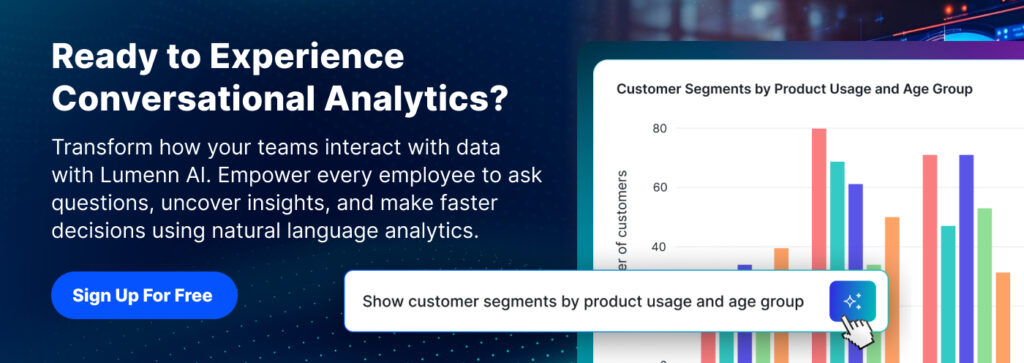

Organizations today generate more data than ever before. Yet, many business teams still struggle to turn that data into timely, actionable insights. Traditional Business Intelligence (BI) tools have long been the foundation of enterprise analytics, but they often require technical expertise, lengthy reporting cycles, and heavy dependence on data teams.
As organizations embrace Artificial Intelligence, a new approach is emerging: Conversational Analytics.
Conversational Analytics is transforming how businesses interact with data by enabling users to ask questions in natural language and receive instant insights, visualizations, and recommendations. Instead of navigating complex dashboards or writing SQL queries, users can simply ask questions in plain English.
This shift is fundamentally changing enterprise analytics workflows.
What Is Conversational Analytics?
Conversational Analytics allows users to interact with data using natural language, much like having a conversation with a colleague.
Users can ask questions such as:
- “What were our top-selling products last quarter?”
- “Which region experienced the highest customer churn?”
- “Show monthly revenue trends for the past year.”
The analytics platform interprets the query, generates the required SQL, retrieves the relevant data, and presents insights through charts, tables, and textual explanations.
This approach democratizes data access by making analytics accessible to both technical and non-technical users.
The Limitations of Traditional BI Workflows
Traditional BI platforms have served organizations well for decades. However, modern businesses demand greater speed, flexibility, and accessibility.
Common Challenges with Traditional BI
- Heavy dependence on IT and data teams.
- Long turnaround times for report generation.
- Complex dashboard navigation.
- Requirement for SQL or technical expertise.
- Difficulty scaling analytics across business users.
- Static reports that quickly become outdated.
In many organizations, business users submit requests to analytics teams, wait for reports, review results, and then request further modifications. This cycle often delays decision-making.
Why Conversational Analytics Is Replacing Traditional BI Workflows
Modern organizations require real-time intelligence and self-service analytics capabilities.
1. Faster Access to Insights
Traditional reporting workflows can take days or even weeks. Conversational Analytics significantly reduces this delay.
Users can ask questions directly and receive immediate answers, enabling faster business decisions and improved operational agility.
2. Reduced Dependence on Technical Teams
Business users no longer need to rely entirely on analysts or data engineers for every question.
By allowing employees to query data independently, organizations free technical teams to focus on strategic initiatives rather than repetitive reporting tasks.
3. Self-Service Analytics for Everyone
Conversational Analytics expands data access beyond analysts.
Teams across finance, sales, operations, marketing, healthcare, manufacturing, and product management can explore data without specialized training.
This creates a truly data-driven culture across the organization.
4. Natural Language as the New Analytics Interface
Traditional BI platforms often require users to understand data models, filters, and complex dashboards.
Conversational interfaces eliminate this complexity.
Instead of searching through multiple reports, users simply ask questions in plain language and receive relevant answers instantly.
Key Benefits of Conversational Analytics
Improved Decision-Making
Real-time access to insights enables organizations to make informed decisions faster.
Increased Productivity
Employees spend less time building reports and more time acting on insights.
Higher Analytics Adoption
When analytics becomes easier to use, adoption naturally increases across teams.
Enhanced Collaboration
Shared dashboards and conversational insights promote alignment across departments.
Greater Business Agility
Organizations can quickly identify trends, opportunities, and risks as business conditions evolve.
Traditional BI vs Conversational Analytics
| Feature | Traditional BI | Conversational Analytics |
|---|---|---|
| User Interface | Dashboards and Reports | Natural Language Queries |
| Technical Skills Required | High | Minimal |
| Speed of Insight | Moderate to Slow | Instant |
| Dependence on Analysts | High | Low |
| Data Exploration | Structured | Interactive |
| Accessibility | Limited | Enterprise-Wide |
The future of analytics lies in reducing friction between questions and answers.
Industries Benefiting from Conversational Analytics
Organizations across industries are adopting conversational analytics to accelerate decision-making.
Retail and Commerce
- Analyze customer behavior.
- Monitor sales performance.
- Optimize inventory levels.
Finance
- Track revenue and expenses.
- Detect anomalies.
- Analyze profitability trends.
Healthcare
- Explore patient outcomes.
- Monitor operational efficiency.
- Analyze treatment performance.
Manufacturing
- Track production KPIs.
- Monitor equipment performance.
- Identify operational bottlenecks.
SaaS and Technology
- Analyze product usage.
- Understand customer churn.
- Monitor feature adoption.
The Role of AI in Modern Analytics Workflows
Artificial Intelligence is becoming central to enterprise analytics.
Modern platforms now offer capabilities such as:
- Natural language querying.
- AI-generated visualizations.
- Automated data quality checks.
- Proactive insight recommendations.
- Explainable AI reasoning.
- Automated dashboard generation.
These innovations enable organizations to move beyond static reporting toward intelligent decision systems.
How Lumenn AI Is Transforming Conversational Analytics
Lumenn AI is redefining enterprise analytics by making data exploration simple, transparent, and accessible to everyone.
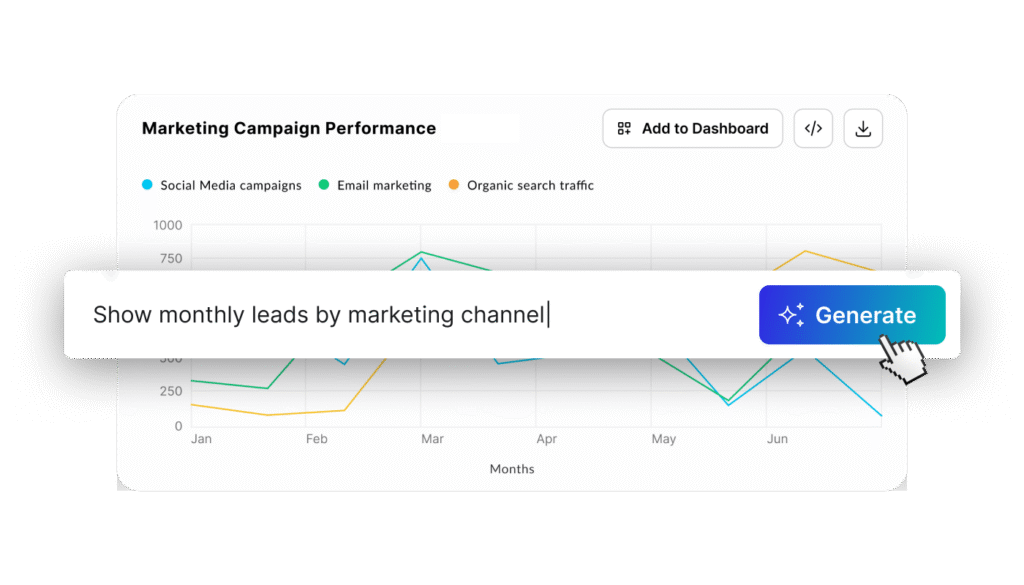
With Lumenn AI, business users can ask questions in plain English and instantly receive charts, tables, and AI-generated insights without writing SQL or relying on technical teams.
Key capabilities include:
Natural Language Business Queries
Ask questions in plain English and instantly generate visualizations, textual explanations, and actionable insights.
No-Code Self-Service Dashboards
Create, manage, and share dashboards without technical expertise while ensuring data stays current through automatic refresh.
Multi-Source Data Integration
Connect securely to enterprise databases and cloud storage platforms without moving data.
AI Auto Analyst
Receive proactive query suggestions and discover hidden trends without starting from scratch.
Data Quality and Governance
Automatically identify duplicates, anomalies, null values, and inconsistencies to ensure trusted analytics.
Chain of Thoughts and SQL Refinery
Build confidence in AI-generated insights through transparent reasoning and natural language-based query refinement.
Lumenn AI empowers organizations to transform data into business-ready intelligence while reducing dependency on traditional BI workflows.
The Future of Business Intelligence Is Conversational
Traditional BI is evolving.
While dashboards and reports will continue to play an important role, the future belongs to conversational, AI-driven analytics experiences that are intuitive, transparent, and accessible to everyone.
Organizations that embrace Conversational Analytics will be better positioned to improve agility, accelerate decision-making, and foster a stronger data culture.
The question is no longer whether businesses should adopt Conversational Analytics.
The real question is: how quickly can they make the transition?