
Enterprise data is growing at an unprecedented pace. Organizations generate millions of records every day across customer interactions, operations, finance, supply chains, and digital platforms. While businesses have more data than ever before, turning that data into actionable insights remains one of their biggest challenges.
Traditional business intelligence tools often require technical expertise, lengthy report creation, and manual data preparation. As a result, business users frequently depend on analysts or IT teams to answer even the simplest questions, delaying decisions and limiting innovation.
Artificial Intelligence is changing that.
AI-powered enterprise analytics is transforming how organizations explore, understand, and act on data. Instead of navigating complex dashboards or writing SQL queries, users can simply ask questions in natural language and receive instant insights backed by intelligent visualizations.
In this blog, we’ll explore how AI is reshaping enterprise data exploration and why it has become a strategic advantage for modern businesses.
Why Traditional Enterprise Data Exploration Falls Short
Most enterprises have invested heavily in data platforms over the years. However, accessing meaningful insights often remains a slow and technical process.
Some of the most common challenges include:
- Data spread across multiple databases and cloud platforms
- Dependence on BI developers for report creation
- Complex dashboards that require specialized training
- Delayed decision-making due to manual reporting
- Limited visibility into real-time business performance
As organizations become more data-driven, these limitations create bottlenecks that reduce business agility.
AI Is Redefining Enterprise Data Exploration
Artificial intelligence is making enterprise analytics more intuitive, accessible, and proactive. Rather than replacing existing data infrastructure, AI enhances how users interact with it.
Instead of searching through dozens of reports, users can simply ask:
- “Which region generated the highest revenue this quarter?”
- “What products experienced declining sales last month?”
- “Which customers have the highest churn risk?”
Within seconds, AI generates meaningful visualizations, summaries, and actionable insights.
This shift allows organizations to spend less time searching for data and more time making informed decisions.
Key Ways AI Is Transforming Enterprise Data Exploration
Natural Language Queries Remove Technical Barriers
One of the biggest innovations in enterprise analytics is the ability to communicate with data using plain English.
Instead of learning SQL or navigating multiple dashboard filters, business users can ask questions naturally.
Benefits include:
- Faster access to business insights
- Reduced dependency on data teams
- Improved collaboration across departments
- Greater adoption of analytics throughout the organization
This democratizes data exploration for everyone, regardless of technical expertise.
AI Connects Data Across Multiple Sources
Enterprise data rarely exists in one location.
Sales data may reside in PostgreSQL.
Financial information could be stored in Snowflake.
Operational metrics might live in Amazon Redshift.
Customer data could come from cloud storage.
AI-powered platforms bring these sources together, allowing users to explore information from multiple systems through one unified experience.
This eliminates fragmented reporting and provides a complete business view.
Real-Time Insights Replace Static Reports
Business environments change continuously.
Waiting days or weeks for updated reports is no longer practical.
Modern AI analytics platforms deliver real-time insights by querying live enterprise data.
Organizations can monitor:
- Revenue performance
- Customer behavior
- Inventory levels
- Operational KPIs
- Marketing effectiveness
This allows leaders to react immediately instead of relying on historical reports.
AI Generates Meaningful Visualizations Automatically
Creating charts traditionally required selecting visualization types, configuring dimensions, and adjusting filters.
AI simplifies the process.
Based on the question asked, the platform automatically recommends the most effective visualization, whether it’s:
- Bar charts
- Line charts
- Pie charts
- Histograms
- Box plots
- Sunburst charts
- Grouped and stacked bar charts
- Interactive tables
The result is faster understanding and better storytelling with data.
Explainable AI Builds Trust
As AI becomes central to business decisions, transparency is becoming increasingly important.
Organizations need to understand not only what the answer is but how it was generated.
Modern enterprise analytics platforms now provide explainable AI capabilities that reveal:
- How the query was interpreted
- Which data sources were used
- What business logic was applied
- How SQL was generated
- How the final visualization was created
This builds confidence while supporting governance and compliance initiatives.
How Lumenn AI Is Transforming Enterprise Data Exploration
Enterprise analytics should be accessible to every employee—not just data specialists.
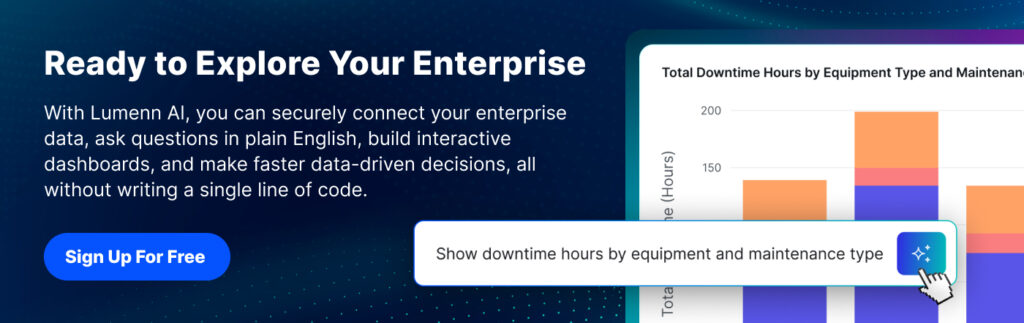
Lumenn AI combines Generative AI with enterprise-grade analytics to simplify how organizations connect, explore, and visualize data.
With Lumenn AI, businesses can:
- Ask questions in natural language and receive instant visual insights.
- Connect securely to multiple enterprise databases without moving data.
- Create self-service dashboards that automatically refresh with live information.
- Upload a Data Dictionary so AI understands business terminology and delivers more accurate insights.
- Improve trust with AI-powered Data Quality checks that identify duplicates, missing values, anomalies, and inconsistencies.
- Use AI Auto Analyst to proactively suggest meaningful business questions based on available datasets.
- Refine AI-generated SQL using SQL Refiner with simple natural language instructions.
- Enable Chain of Thoughts to understand exactly how AI interpreted queries, generated SQL, and produced insights.
Whether you’re in finance, retail, healthcare, manufacturing, SaaS, education, or life sciences, Lumenn AI empowers every team to explore enterprise data confidently without writing code or waiting for IT.
Business Benefits of AI-Powered Enterprise Data Exploration
Organizations adopting AI analytics are experiencing measurable improvements across their operations.
Some of the biggest advantages include:
Faster Decision Making
Teams receive answers in seconds instead of waiting for reports.
Higher Productivity
Business users become self-sufficient without relying on technical resources.
Better Data Confidence
Built-in governance, explainability, and data quality improve trust in every insight.
Improved Collaboration
Departments work from the same live data, reducing conflicting reports.
Scalable Analytics
As businesses grow, AI scales effortlessly across users, departments, and data sources.
The Future of Enterprise Data Exploration
Enterprise analytics is moving beyond dashboards.
The future belongs to intelligent platforms that proactively surface insights, explain their reasoning, and empower every employee to interact with data naturally.
Businesses no longer want static reports.
They expect analytics platforms to be conversational, transparent, collaborative, and continuously learning.
Organizations that embrace AI-powered enterprise data exploration today will be better positioned to innovate, respond faster to change, and make more confident business decisions tomorrow.
Conclusion
AI is fundamentally transforming enterprise data exploration by making analytics faster, simpler, and more accessible than ever before. Instead of relying on technical expertise or waiting for reports, business users can explore live enterprise data through natural conversations, gain instant visual insights, and make decisions with confidence.
As organizations continue to generate larger volumes of data, the ability to explore information intelligently and transparently will become a key competitive advantage.
Platforms like Lumenn AI are leading this transformation by combining natural language analytics, multi-source connectivity, explainable AI, data quality, and self-service business intelligence into one seamless experience.