
Artificial intelligence is changing how businesses analyze data, identify trends, and make decisions. AI can process enormous amounts of information in seconds, uncover patterns, and generate insights that would take teams hours to produce manually.
But speed alone does not create better decisions.
Business leaders also need to understand why an AI system reached a particular conclusion. When teams cannot see how an insight was generated, even an accurate recommendation can be difficult to trust.
This is where transparent AI becomes important.
Transparent AI gives users greater visibility into how AI interprets information, applies logic, and produces its outputs. For organizations using AI for business analytics, this transparency can improve trust, validation, collaboration, and ultimately decision making.
What Is Transparent AI?
Transparent AI refers to AI systems that provide users with meaningful visibility into how outputs are generated.
Instead of simply presenting an answer, a transparent AI system can help users understand the factors, data, logic, or reasoning that contributed to the result.
In business analytics, this can mean understanding:
- How a natural language question was interpreted
- Which data sources were considered
- What filters or conditions were applied
- How calculations or query logic were generated
- How the final insight or visualization was produced
The goal is not to expose unnecessary technical complexity. It is to provide enough context for users to evaluate an AI generated result with confidence.
Why Transparency Matters in AI Driven Business Decisions
Businesses make decisions based on analytics every day. Revenue forecasts influence investments. Customer insights influence marketing strategies. Operational metrics influence resource allocation.
When AI becomes part of these workflows, decision makers need confidence that the information behind those decisions is reliable.
Trust Becomes a Business Requirement
An AI generated insight may look convincing, but users still need to know whether it is based on the right data and logic.
Transparency helps answer questions such as:
Where did this insight come from?
What data was used?
Why did the AI interpret the question this way?
Can the result be validated?
When these questions can be answered, teams are more likely to adopt AI as part of their everyday decision making.
How Transparent AI Improves Business Decisions
1. Helps Teams Validate AI Generated Insights
One of the biggest advantages of transparent AI is the ability to validate results before acting on them.
For example, a sales leader may ask an analytics platform to identify the regions with declining revenue. Instead of simply receiving a chart, users can benefit from understanding how the query was interpreted and which conditions were applied.
This makes it easier to identify potential misunderstandings before they influence an important business decision.
2. Reduces the Risk of Misinterpretation
Natural language makes analytics accessible, but business questions can sometimes be ambiguous.
Consider a question such as:
“Show our best customers this year.”
What does “best” mean?
It could refer to revenue, order frequency, profit, customer lifetime value, or another business metric.
Transparent AI can provide greater visibility into how the question was interpreted. This allows users to recognize whether the resulting analysis matches their intended business definition.
3. Makes AI More Accessible to Business Users
AI analytics is often designed to remove technical barriers. Business users should not need to understand SQL or complex data models to explore information.
However, removing technical complexity should not mean removing control.
Transparent AI creates a balance between simplicity and visibility. Users can interact with data using natural language while still having access to the logic behind the generated insight when they need it.
This makes AI analytics more approachable without turning it into a black box.
Transparency Strengthens Collaboration Between Teams
AI analytics can bring business and technical teams closer together.
Traditionally, a business user might ask a data analyst for a report. The analyst translates the request into technical logic, produces the analysis, and sends the result back. If the requirement changes, the process starts again.
Transparent AI can shorten this cycle.
Business Teams Gain More Context
Business users can better understand how their questions translate into analytics.
Data Teams Gain Greater Visibility
Analysts can review the logic behind AI generated outputs and identify potential improvements.
Teams Can Align Faster
When both sides can see how an insight was produced, conversations become more specific and productive.
Instead of debating whether an answer “looks right,” teams can discuss the underlying data and logic.
Transparent AI Supports Better Governance
As organizations scale AI adoption, governance becomes increasingly important.
Businesses need to know how AI is being used, what information influences its outputs, and whether decisions can be explained when required.
Transparent AI can support governance by providing greater visibility into analytical workflows.
Important areas include:
- Traceability of AI generated insights
- Visibility into data sources
- Understanding of query logic
- Consistent business definitions
- Greater accountability around AI assisted decisions
Transparency does not replace a complete AI governance framework, but it can become an important layer within one.
Transparency Does Not Mean Exposing Everything
A common misconception is that explainable AI requires users to understand every technical detail behind an AI system.
That is not necessarily the case.
Effective transparency should be useful, contextual, and accessible.
A business executive may need a clear explanation of the data and logic used. A data analyst may want deeper technical details. Different users can require different levels of visibility.
The best AI analytics experiences provide transparency without overwhelming users.
How Lumenn AI Brings Transparency to Enterprise Analytics
Lumenn AI is designed around a simple idea: AI should make analytics easier without making it less understandable.
With natural language analytics, users can ask questions about enterprise data without writing SQL. But when users need more control and visibility, Lumenn AI provides capabilities that help them understand and refine the analytical process.
Chain of Thoughts
Lumenn AI’s Chain of Thoughts feature allows users to choose when they want greater visibility into how an insight was generated.
By enabling the reasoning option before generating an insight, users can see a structured explanation covering areas such as query interpretation, data sources, applied filters and logic, SQL generation, and how the resulting insight or visualization was derived.
This gives users a clearer view of the analytical path behind an AI generated answer.
SQL Refiner
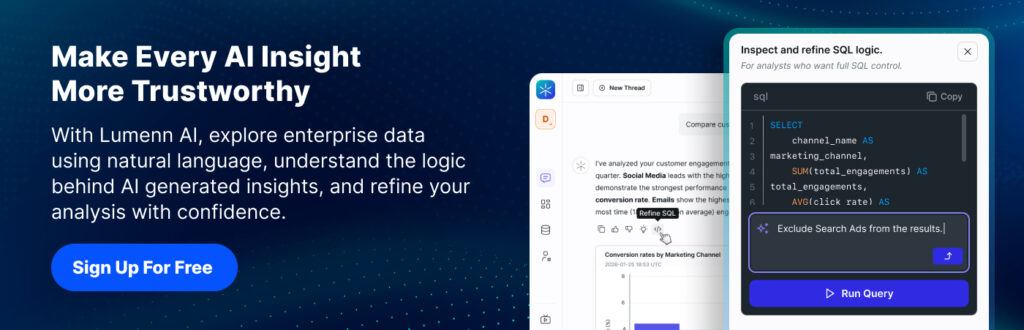
Lumenn AI also gives users greater control through SQL Refiner.
After an insight is generated, users can view the SQL logic and describe changes using natural language. They can request refinements to filters, time ranges, conditions, or other query logic without manually rewriting the SQL.
The updated query can then be regenerated to produce a refreshed insight.
Together, Chain of Thoughts and SQL Refiner bring transparency and control into conversational analytics.
From AI Answers to Confident Decisions
The future of enterprise analytics is not simply about generating answers faster.
It is about helping people understand, validate, and act on those answers.
Transparent AI gives organizations a way to combine the efficiency of artificial intelligence with the judgment of human decision makers. It helps teams move beyond simply asking whether an AI generated insight is correct and toward understanding why the insight was produced.
That shift can make AI more trustworthy, practical, and valuable across the enterprise.
As organizations continue adopting AI, the winners will not necessarily be those using the most AI. They will be the organizations that know when to trust it, how to validate it, and how to use it responsibly.
Make AI Analytics More Transparent with Lumenn AI
Lumenn AI helps businesses turn enterprise data into actionable insights through natural language analytics, while giving users greater visibility and control over AI generated results.
Explore your data, understand the logic behind your insights, refine analysis when needed, and make decisions with greater confidence.