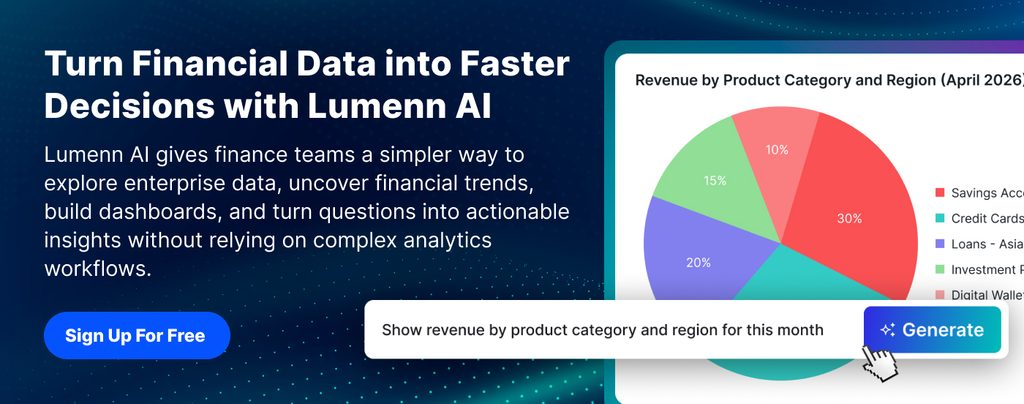

Finance teams are under constant pressure to answer one fundamental question: Are we growing profitably?
Revenue may be increasing, but rising operating costs can quietly reduce margins. A profitable quarter may hide underperforming business units. And by the time a traditional report highlights the problem, the opportunity to act may already be gone.
This is where AI analytics for finance can make a meaningful difference.
By combining enterprise data with artificial intelligence, modern analytics platforms help finance teams explore revenue, costs, margins, and profitability through natural language. Instead of spending hours preparing reports, finance professionals can ask questions, uncover trends, and move from numbers to decisions faster.
Why Finance Teams Need Faster Analytics
Financial data is rarely stored in one place. Revenue may come from ERP systems, expenses from accounting platforms, customer information from CRM systems, and operational costs from other enterprise databases.
Bringing these numbers together for analysis can take significant time. Finance teams often depend on predefined reports or data specialists whenever they need a new analysis.
AI analytics changes this workflow by making financial data easier to explore. Teams can ask questions in plain language and receive visual insights without having to manually build every report or write SQL queries.
How AI Analytics Helps Finance Teams
AI analytics can support finance teams across the entire financial monitoring process, from tracking revenue performance to understanding cost drivers and identifying profitability trends.
Monitor Revenue Performance
Revenue is one of the most important indicators of business health, but looking at total revenue alone rarely tells the complete story.
Finance teams need to understand where revenue is coming from, how it is changing, and which segments are contributing most to growth.
With AI analytics, users can ask questions such as:
“What was our revenue by region this quarter?”
“Which products generated the highest revenue last month?”
“How has revenue changed compared with the previous quarter?”
The resulting charts and insights make it easier to identify growth patterns, performance gaps, and emerging trends.
Understand and Track Costs
Revenue growth means little if costs are growing faster.
AI analytics helps finance teams examine expenses across departments, locations, vendors, products, and other business dimensions. Instead of manually filtering spreadsheets or waiting for recurring reports, users can investigate cost movements through natural language.
For example, a finance leader could ask:
“Which departments had the highest increase in operating costs this quarter?”
This can quickly highlight where spending is changing and where further investigation may be needed.
Analyze Profitability and Margins
Profitability requires looking at revenue and costs together.
AI analytics enables finance teams to explore profit margins across products, regions, customer segments, business units, or time periods. This helps identify areas that generate strong revenue but deliver weaker margins.
Questions such as “Which regions have the highest profit margin?” can turn complex financial datasets into easy to understand visual insights.
The value is not simply seeing profitability. It is understanding the factors influencing it.
Identify Financial Trends Earlier
Traditional financial analysis often focuses on what already happened. AI powered analytics can help teams explore patterns as they emerge.
Finance professionals can investigate unusual changes in revenue, unexpected cost increases, or differences between business segments. Visualizations make these patterns easier to spot, while conversational analysis allows teams to immediately investigate the next question.
This creates a more iterative approach to financial analysis.
Instead of producing one report and moving on, teams can continuously ask, investigate, compare, and refine.
Reduce Dependence on Manual Reporting
Financial reporting can involve repetitive work such as collecting data, preparing spreadsheets, creating charts, and responding to follow up requests.
AI analytics can reduce this burden by allowing business users to generate insights themselves.
A finance leader does not necessarily need to submit a request for every new analysis. They can ask a question directly, explore the resulting visualization, and continue the analysis based on what they discover.
This allows finance teams to spend less time preparing information and more time interpreting it.
Make Financial Analysis More Accessible
AI analytics is not only valuable for finance analysts.
Executives, business managers, and department leaders increasingly need access to financial insights to make informed decisions. Natural language analytics makes interaction more approachable.
Users can ask questions in everyday language instead of learning complex analytics tools or SQL.
This creates a more collaborative data culture where financial insights can be explored closer to the point of decision making.
Build More Confidence in AI Generated Insights
Speed is important, but financial decisions also require trust.
Modern AI analytics platforms need to provide transparency around how insights are generated. Features such as data quality checks, query visibility, natural language refinement, and structured reasoning can help users better understand and validate AI generated results.
For finance teams, this additional visibility can make AI analytics easier to adopt in environments where accuracy, governance, and accountability matter.
How Lumenn AI Supports Finance Teams
Lumenn AI brings conversational enterprise analytics directly into the financial analysis workflow.
Finance teams can connect their enterprise data sources and ask questions in natural language to explore revenue, expenses, profitability, and other business metrics. Lumenn AI transforms these questions into visual insights such as charts, tables, and explanatory summaries.
Ask Financial Questions in Plain Language
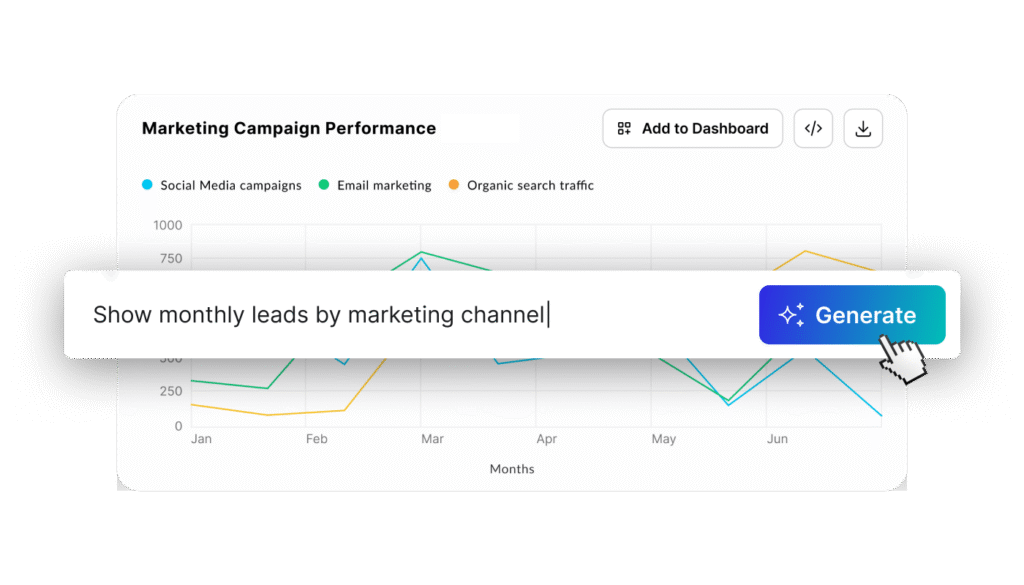
Instead of manually building every analysis, finance teams can simply ask questions about their data and receive visual answers.
Explore Revenue, Costs, and Profitability
Users can investigate financial performance across relevant dimensions, compare periods, identify trends, and drill into areas that require attention.
Create Self Service Dashboards
Important financial visualizations can be added to dashboards, allowing teams to monitor KPIs in one place. Dashboards can automatically refresh as underlying data updates.

Improve Confidence with Data Quality
Lumenn AI provides AI-powered data quality checks that help identify issues such as nulls, duplicates, inconsistencies, and anomalies before they affect analytics.

Keep Business Context in the Analysis
With Lumenn AI’s Data Dictionary, organizations can provide definitions for business terms, metrics, and fields. This helps the AI understand the organization’s terminology and deliver more context-aware insights.

The Future of Financial Analytics Is More Conversational
Finance teams do not need more complexity. They need faster access to reliable information and the ability to explore the questions that matter.
AI analytics is helping transform financial analysis from a reporting exercise into a continuous decision-making process. Revenue, costs, and profitability can be explored through simple questions, while visual analytics makes complex financial information easier to understand.
The result is a finance function that can respond faster, investigate deeper, and make decisions with greater confidence.