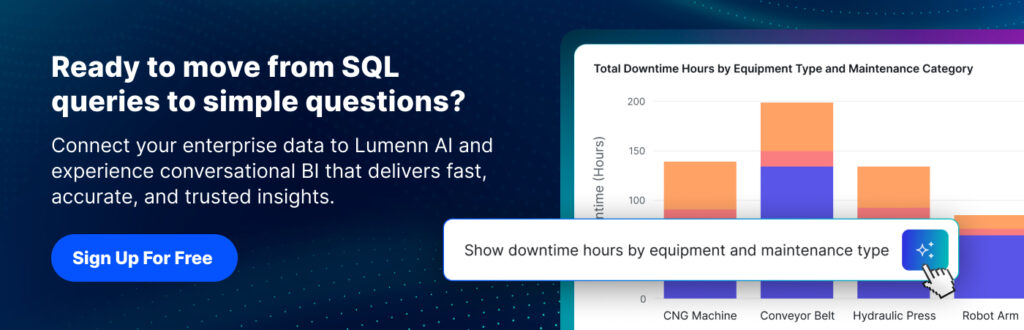

For decades, accessing business insights required one thing above all else: technical expertise. Analysts wrote SQL queries, business users waited for reports, and insights arrived only after long cycles of back-and-forth. While data volumes increased, the ability to ask questions of that data remained limited to a small group of experts.
Today, that model is changing. Conversational Business Intelligence, or conversational BI, is redefining how organizations interact with data. Instead of writing SQL or navigating complex dashboards, users can now ask questions in plain language and receive immediate, visual insights. This shift is transforming enterprise analytics from a technical process into an accessible, everyday capability.
The Problem with Traditional BI and SQL-Driven Analytics
SQL has long been the backbone of analytics. It is powerful, precise, and flexible. But it also creates barriers.
Why SQL Slows Down Decision Making
Most business users are not trained to write SQL. As a result, organizations often rely on centralized analytics or BI teams to answer even simple questions. This leads to:
- Long turnaround times for reports
- Bottlenecks around data teams
- Static dashboards that quickly become outdated
- Limited exploration beyond predefined metrics
By the time insights are delivered, the business context may have already changed.
Dashboards Alone Are Not Enough
Traditional dashboards help visualize data, but they are usually built around fixed assumptions. When users want to explore something new, filter differently, or ask a follow-up question, they are often forced back into request queues or manual workflows.
This rigid approach limits agility in a world where decisions must be made faster than ever.
What Is Conversational BI
Conversational BI allows users to interact with data using natural language. Instead of writing queries or navigating complex interfaces, users can simply ask questions such as:
- “What were our top selling products last quarter?”
- “How did revenue trend by region this year?”
- “Which customers show unusual behavior this month?”
Behind the scenes, AI translates these questions into accurate queries, analyzes the data, and presents insights through charts, tables, and clear explanations.
The Core Idea Behind Conversational BI
At its core, conversational BI is about removing friction. It replaces technical syntax with human language and turns analytics into a dialogue rather than a task.
How Conversational BI Works
Natural Language Understanding
AI models interpret user questions, understand intent, and map business terms to underlying data fields. This allows the system to respond accurately even when questions are phrased differently.
Automated Query Generation
Once intent is understood, the system generates the appropriate query behind the scenes. Users do not need to see or write SQL to get reliable results.
Instant Visual Insights
Results are returned as visualizations, such as bar charts, line graphs, or tables, along with text based explanations that summarize key findings.
Why Conversational BI Is Gaining Momentum
Democratization of Data
Conversational BI makes analytics accessible to everyone, not just analysts. Sales teams, marketing managers, operations leaders, and executives can explore data independently.
Faster Time to Insight
By eliminating technical steps and manual requests, insights are generated in seconds rather than days.
Encouraging Exploration
When asking questions is easy, users naturally explore more. This leads to deeper understanding, better decisions, and fewer blind spots.
Conversational BI in Enterprise Environments
While conversational BI offers clear benefits, enterprise adoption requires more than just a chat interface.
Accuracy and Trust
Enterprises need confidence that AI generated insights are correct. This means robust query generation, data quality validation, and transparency into how results are produced.
Security and Governance
Enterprise analytics must respect role based access, data privacy, and governance policies. Conversational BI platforms must ensure users only see data they are authorized to access.
Context Matters
Business terminology varies across organizations. Conversational BI works best when it understands the context of the data, including definitions, metrics, and relationships.
The Role of Conversational BI in Self Service Analytics
Conversational BI is a natural extension of self service analytics. It removes the final technical barrier by allowing users to engage with data intuitively.
From Questions to Dashboards
Insights generated through conversations can be saved, shared, and organized into dashboards. This allows teams to move seamlessly from exploration to monitoring.
Supporting Continuous Intelligence
Instead of static reports, conversational BI supports ongoing analysis. Users can ask follow up questions, refine insights, and adapt as business conditions change.
How Lumenn AI Enables Conversational BI
Lumenn AI brings conversational BI into the enterprise with a focus on simplicity, trust, and scale.
Ask Questions in Plain Language
Users can query enterprise data using natural language without writing SQL or using complex BI tools.
Accurate Visual and Text Insights
Lumenn AI returns both visualizations and clear explanations, making insights easy to understand and act on.
Transparency and Control
For advanced users, Lumenn AI provides visibility into the underlying queries, helping build trust in AI generated results.
From Conversations to Dashboards
Insights generated through conversations can be added to dashboards that stay updated with live data, enabling collaboration and decision tracking.

The Future of Business Intelligence Is Conversational
As organizations generate more data, the ability to interact with it intuitively becomes a competitive advantage. Conversational BI shifts analytics from a technical function to a business capability.
In the future, asking questions of data will feel as natural as asking questions of colleagues. Analytics will become continuous, contextual, and embedded into daily workflows.
Enterprises that embrace conversational BI will move faster, explore deeper, and make decisions with greater confidence.
Final Thoughts
The rise of conversational BI marks a fundamental shift in how businesses use data. Moving from SQL to simple questions removes friction, accelerates insights, and empowers every user to engage with analytics.
By combining natural language, AI driven intelligence, and enterprise grade governance, conversational BI transforms analytics from a specialized skill into a shared capability.