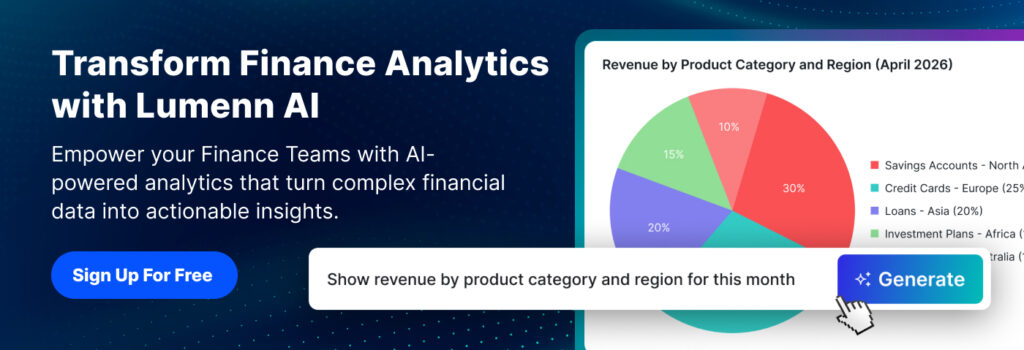

The role of finance has evolved dramatically over the past few years. No longer limited to reporting historical numbers, modern Finance Teams are expected to deliver real-time insights, improve forecasting accuracy, identify risks early, and support strategic business decisions.
However, many organizations still rely on spreadsheets, static reports, and fragmented data systems. As data volumes continue to grow, traditional approaches are struggling to keep pace. This is one of the key reasons why Finance Teams are increasingly adopting AI-driven Analytics Platforms to modernize financial analysis and decision-making.
AI is transforming finance by enabling faster access to insights, automating repetitive tasks, improving forecasting accuracy, and helping organizations make more confident decisions based on real-time data. Industry research shows that finance leaders are rapidly increasing investments in AI technologies to improve efficiency, reporting, and strategic planning.
The Growing Challenges Facing Finance Teams
Today’s finance departments operate in a highly dynamic environment where business conditions can change overnight.
Common challenges include:
| Challenge | Impact |
|---|---|
| Data spread across multiple systems | Delayed reporting and limited visibility |
| Manual reporting processes | Increased workload and higher risk of errors |
| Static dashboards | Slow decision-making |
| Spreadsheet dependency | Data inconsistencies and version-control issues |
| Forecasting uncertainty | Reduced planning accuracy |
| Growing compliance requirements | Increased governance burden |
As organizations scale, these challenges become even more difficult to manage. Finance professionals often spend significant time collecting, cleaning, and reconciling data instead of analyzing it and generating business value.
What Are AI-Driven Analytics Platforms?
AI-driven Analytics Platforms combine artificial intelligence, machine learning, natural language processing, and advanced analytics to help organizations transform raw financial data into actionable insights.
Unlike traditional business intelligence tools, these platforms can:
- Analyze large datasets automatically
- Detect trends and anomalies
- Generate insights in real time
- Support natural language queries
- Improve forecasting and planning
- Automate repetitive analytical tasks
For Finance Teams, this means spending less time preparing reports and more time driving strategic decisions.
Why Finance Teams Are Adopting AI-Driven Analytics Platforms
Faster Access to Financial Insights
Traditional reporting cycles often require hours or even days of data preparation before insights become available.
With AI-driven Analytics Platforms, finance professionals can analyze live data instantly and receive answers to critical business questions in seconds.
Examples
- What is our current cash position?
- Which business unit has the highest operating margin?
- How has revenue changed compared to last quarter?
- What expenses are growing faster than expected?
By reducing reporting delays, Finance Teams can react faster to changing business conditions.
Improved Forecasting and Planning
Forecasting is one of the most important responsibilities of modern finance organizations.
Unfortunately, traditional forecasting methods often rely heavily on historical data and manual assumptions.
AI enhances forecasting by:
- Identifying hidden patterns
- Continuously analyzing new data
- Detecting emerging trends
- Supporting scenario planning
Organizations using AI-powered finance solutions are increasingly leveraging predictive capabilities to improve planning accuracy and support more agile decision-making.
Reduced Dependence on Technical Teams
Many finance professionals depend on analysts or IT teams to build reports and dashboards.
This often creates bottlenecks.
Modern AI-driven Analytics Platforms allow users to interact with data using natural language.
Example
Instead of writing SQL queries, users can simply ask:
“Show operating expenses by department for the last six months.”
The platform automatically generates the required analysis and visualizations.
This self-service approach empowers Finance Teams to explore data independently and make decisions faster.
Real-Time Visibility Across the Business
Finance leaders need visibility across multiple departments, systems, and data sources.
AI-powered platforms can connect to:
- ERP systems
- Accounting software
- CRM platforms
- Operational databases
- Cloud data warehouses
This creates a unified view of business performance.
Rather than waiting for monthly reports, Finance Teams can monitor key metrics continuously and identify issues before they become major problems.
Why Finance Teams Choose Lumenn AI
Modern Finance Teams need more than dashboards; they need instant access to trusted insights that help them plan, forecast, and make decisions with confidence. Lumenn AI is built to simplify financial analytics by combining conversational AI, self-service reporting, and enterprise-grade governance in a single platform.
Instead of waiting for technical teams to build reports, finance professionals can simply ask questions in natural language and receive instant visualizations, summaries, and actionable insights. Whether you’re analyzing revenue performance, monitoring expenses, tracking profitability, or forecasting cash flow, Lumenn AI makes complex financial data easy to explore and understand.
What Makes Lumenn AI Different?
Natural Language Analytics
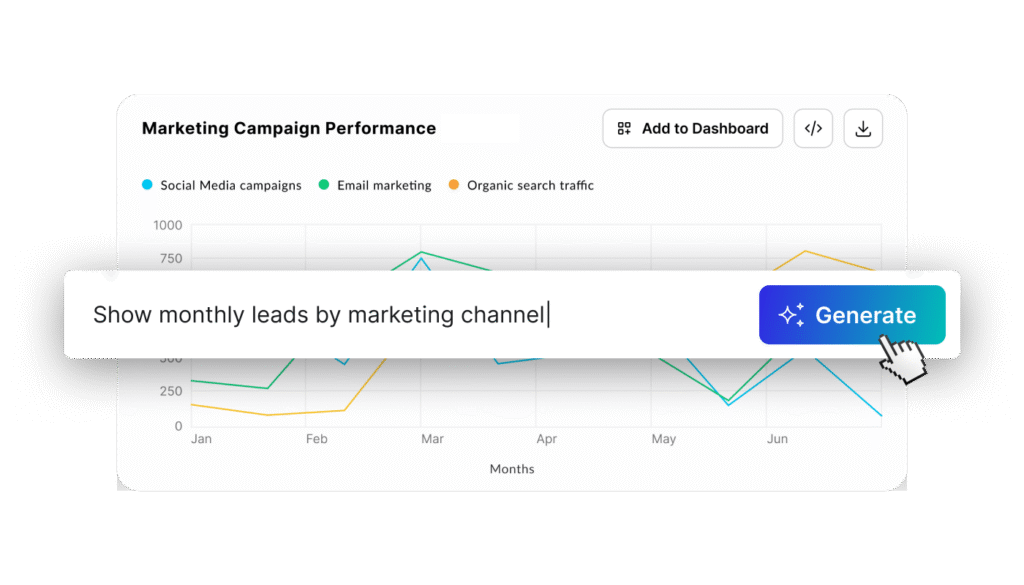
Ask questions in plain English and instantly generate financial insights, charts, and reports—without writing SQL or relying on technical resources.
AI-Powered Data Exploration
Discover trends, anomalies, and performance drivers across financial datasets faster than traditional reporting methods.
Connect Data Where It Lives
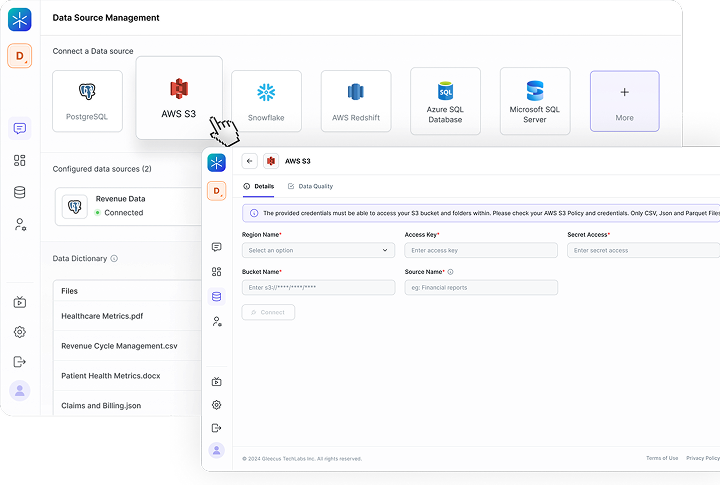
Securely connect to databases, cloud warehouses, and enterprise systems without moving data. Lumenn AI queries data in place, ensuring security and compliance.
Self-Service Dashboards
Create and share finance dashboards that track key metrics such as revenue, expenses, profitability, cash flow, and budget performance in real time.

AI-Powered Data Quality
Improve trust in your financial reporting with automated checks for missing values, duplicates, inconsistencies, and anomalies.

Enterprise Security & Governance
Protect sensitive financial information with role-based access controls, audit logs, and enterprise-grade security controls designed for modern organizations.

The Future of Finance Is AI-Powered
The finance function is rapidly evolving from a reporting center into a strategic decision-making hub.
AI is enabling finance professionals to move beyond manual reporting and focus on higher-value activities such as:
- Strategic planning
- Business partnering
- Risk management
- Performance optimization
- Growth forecasting
Industry experts increasingly view AI as a foundational component of the future finance operating model, helping organizations unify data, automate workflows, and deliver insights at scale.
For organizations seeking faster decisions, improved forecasting, and greater operational efficiency, AI-driven Analytics Platforms are becoming an essential part of the modern finance technology stack.
Conclusion
As business environments become more complex and data volumes continue to grow, traditional finance tools are no longer sufficient.
Finance Teams need faster access to insights, greater visibility across operations, improved forecasting capabilities, and trusted data for decision-making. AI-driven Analytics Platforms provide exactly that by combining automation, intelligence, and real-time analytics into a single experience.
The organizations that embrace AI-powered finance analytics today will be better positioned to improve agility, reduce risk, and make smarter decisions tomorrow.