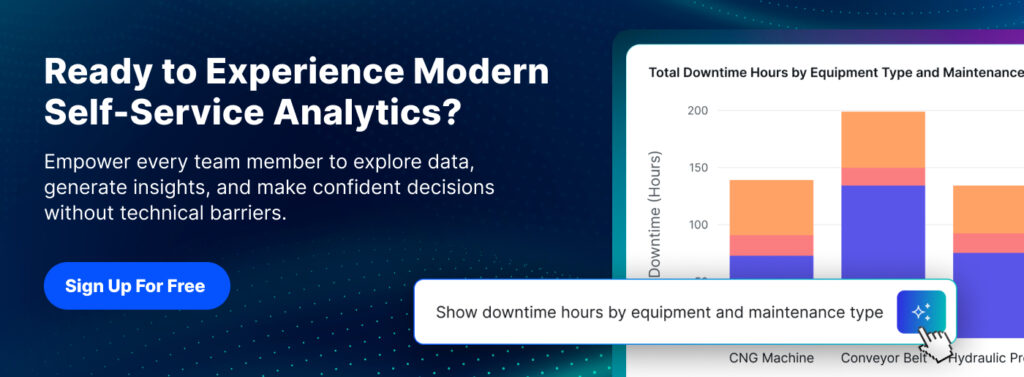

Data has become one of the most valuable assets for modern enterprises. Yet, many organizations still struggle to turn data into timely decisions. Traditional Business Intelligence (BI) platforms have long been the standard for reporting and analytics, but they often rely heavily on technical teams, lengthy development cycles, and complex workflows.
As businesses demand faster insights and greater agility, Self-Service Analytics has emerged as a transformative approach. It empowers business users to explore data, generate reports, and uncover insights independently without relying on data specialists for every request.
But how does Self-Service Analytics compare to Traditional BI? More importantly, which approach is better suited for today’s enterprise environment?
In this guide, we’ll explore the key differences, benefits, challenges, and why enterprises are increasingly adopting AI-powered self-service analytics platforms.
What is Traditional BI?
Traditional Business Intelligence refers to centralized analytics systems where data teams, analysts, or BI developers create reports, dashboards, and data models for business users.
In a traditional BI environment, users typically submit requests for reports and wait for technical teams to prepare and deliver insights.
Characteristics of Traditional BI
- Centralized reporting processes
- Heavy reliance on IT and BI teams
- Predefined dashboards and reports
- Longer turnaround times for new requests
- SQL and technical expertise often required
- Limited flexibility for business users
While Traditional BI has played a critical role in enterprise reporting, organizations today require more speed and flexibility than these systems often provide.
What is Self-Service Analytics?
Self-Service Analytics allows business users to access, analyze, and visualize data without requiring deep technical expertise.
Modern self-service platforms use intuitive interfaces, AI-driven assistance, and natural language querying to help users generate insights independently.
Instead of waiting days or weeks for reports, teams can explore data and answer business questions instantly.
Characteristics of Self-Service Analytics
- Natural language data exploration
- No-code or low-code experience
- Faster access to insights
- Reduced dependence on technical teams
- Real-time decision support
- Greater accessibility across departments
Self-Service Analytics democratizes data by making it available to everyone, not just data experts.
Self-Service Analytics vs. Traditional BI: Key Differences
1. Speed of Insight Generation
Traditional BI
Business users often submit requests to data teams and wait for reports to be created or updated.
Self-Service Analytics
Users can ask questions directly and receive answers in seconds.
Result: Faster decision-making and reduced reporting bottlenecks.
2. Dependency on Technical Teams
Traditional BI
Requires analysts, BI developers, and database specialists to build reports and dashboards.
Self-Service Analytics
Empowers business users to explore data independently.
Benefits include:
- Reduced IT workload
- Faster business responses
- Improved organizational agility
- Better collaboration across teams
3. Ease of Use
Traditional BI
Many traditional tools require understanding of:
- SQL
- Data models
- Report design
- Dashboard configuration
Self-Service Analytics
Modern platforms allow users to simply ask questions like:
- What were our top-selling products last quarter?
- Which region generated the highest revenue?
- What is our churn trend this year?
The platform automatically generates visualizations and insights.
4. Scalability Across Business Teams
Traditional BI often limits data access to a small group of experts.
Self-Service Analytics expands access across:
- Sales teams
- Marketing departments
- Finance teams
- Operations leaders
- Product managers
- Executive stakeholders
This creates a stronger data-driven culture throughout the organization.
5. Flexibility and Exploration
Traditional BI
Most reports are predefined and static.
Users often cannot explore beyond the available dashboard views.
Self-Service Analytics
Users can:
- Ask follow-up questions
- Create custom visualizations
- Explore trends independently
- Build dashboards on demand
This flexibility accelerates discovery and innovation.
6. Cost and Resource Efficiency
Maintaining traditional BI environments can require significant investment in:
- Data engineering
- Report development
- Dashboard maintenance
- User support
Self-Service Analytics reduces operational overhead by enabling users to perform many analytics tasks independently.
Organizations can focus technical resources on strategic initiatives rather than routine reporting requests.
Why Enterprises Are Moving Toward Self-Service Analytics
Several factors are driving this shift.
Growing Data Volumes
Businesses generate more data than ever before. Centralized reporting teams struggle to keep up with increasing demand.
Faster Business Cycles
Markets change rapidly. Leaders need answers immediately, not next week.
Democratization of Data
Organizations want every employee to leverage data effectively.
Advances in AI
Artificial Intelligence has made analytics significantly more accessible through natural language interactions and automated insights.
As a result, self-service analytics is becoming a strategic requirement rather than a competitive advantage.
How Lumenn AI Makes Self-Service Analytics Truly Enterprise Ready
Many analytics platforms claim to offer self-service capabilities. However, enterprise adoption requires more than easy dashboards.
Lumenn AI combines the simplicity of self-service analytics with the governance, transparency, and scalability enterprises need.
Natural Language Analytics
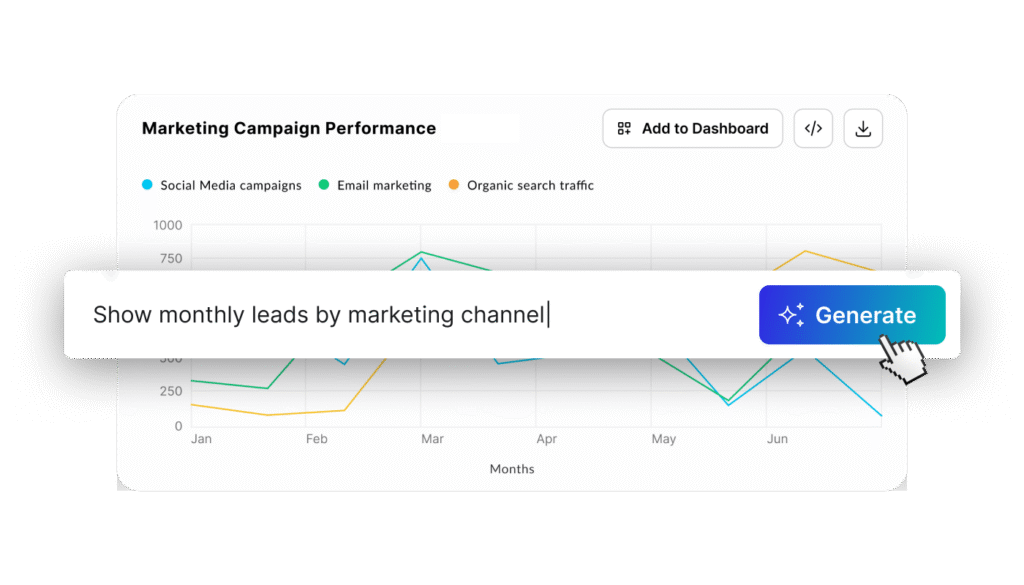
Lumenn AI removes the complexity of traditional analytics by allowing users to ask questions in plain English and instantly receive visualizations, reports, and actionable insights. Business users can explore data independently without SQL knowledge or technical expertise, making analytics accessible across the organization.
AI Auto Analyst
Getting started with data exploration can be challenging. Lumenn AI’s AI Auto Analyst proactively analyzes connected datasets and suggests relevant business questions and areas of interest. Instead of wondering what to ask, users can immediately begin exploring meaningful insights and trends.

Chain of Thoughts
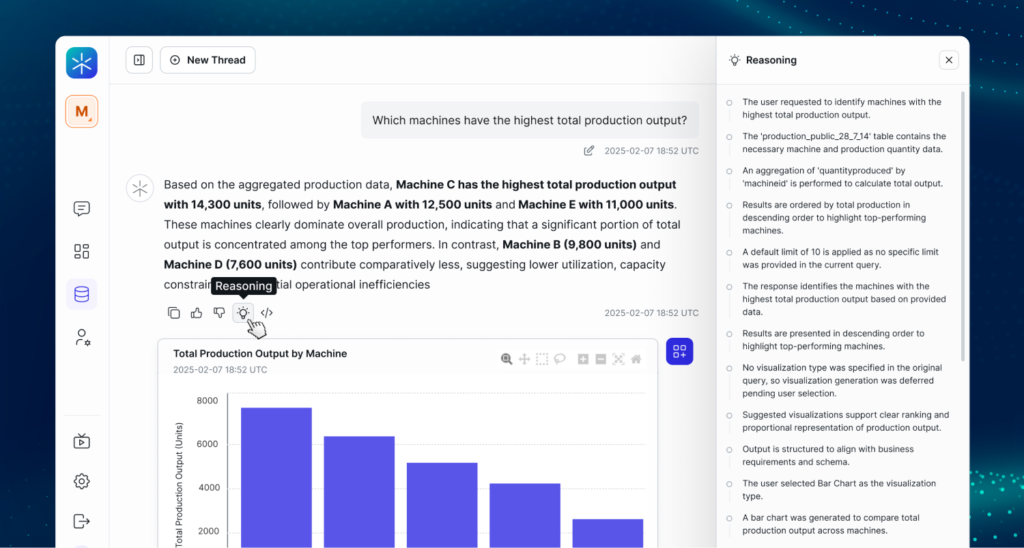
Trust is essential in enterprise analytics. Chain of Thoughts provides transparency by showing the reasoning behind AI-generated insights. Users can understand how their query was interpreted, what logic was applied, which data sources were used, and how the final insight was generated, creating confidence in every decision.
SQL Refiner
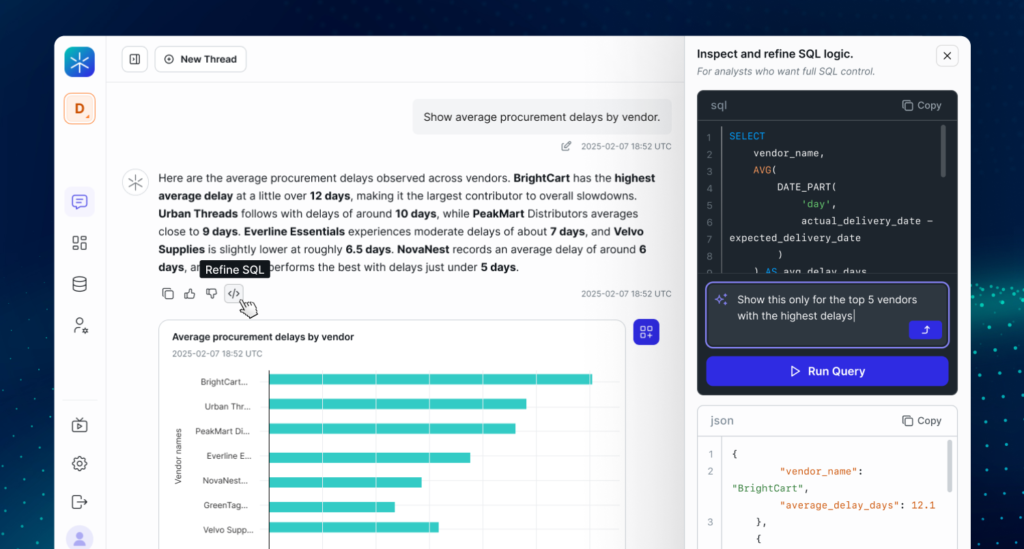
Lumenn AI gives users greater control over analytics without requiring SQL expertise. After an insight is generated, users can refine the underlying query using natural language instructions. Whether adjusting filters, changing date ranges, or modifying business logic, insights can be updated instantly without starting from scratch.
Enterprise Data Integration
Organizations rely on multiple systems to run their business. Lumenn AI securely connects to leading databases, data warehouses, and cloud storage platforms, allowing teams to analyze live data from across the enterprise. With in-place querying, data remains in its original environment while users gain access to real-time insights

AI-Powered Data Quality
Reliable decisions depend on reliable data. Lumenn AI automatically evaluates data quality by identifying issues such as missing values, duplicates, inconsistencies, and anomalies. By highlighting potential data concerns before analysis begins, the platform helps organizations improve trust in their reports, dashboards, and AI-generated insights.

Self-Service Dashboards
Lumenn AI enables users to build and manage dashboards without technical assistance. Visualizations generated through natural language queries can be added directly to dashboards, creating a centralized view of key metrics. Dashboards stay current through configurable auto-refresh schedules and can be easily shared across teams.

Enterprise Security and Governance
Designed for enterprise environments, Lumenn AI includes role-based access controls, audit logs, and encryption to ensure secure access to data and analytics. Combined with explainable AI capabilities, these controls help organizations meet governance, compliance, and accountability requirements while expanding access to insights.

Choosing the Right Analytics Approach
The choice is no longer simply between Traditional BI and Self-Service Analytics.
Modern enterprises need both governance and accessibility.
The ideal platform should deliver:
- Ease of use
- Enterprise security
- Explainable AI
- Data quality controls
- Multi-source integration
- Self-service exploration
- Real-time insights
Organizations that successfully combine these capabilities gain a significant competitive advantage.
Conclusion
Traditional BI laid the foundation for enterprise reporting, but modern business demands have changed dramatically. Organizations need faster access to insights, broader data accessibility, and greater agility than traditional approaches can often provide.
Self-Service Analytics empowers business users to answer questions independently, explore data confidently, and make decisions faster.
As AI continues to transform enterprise analytics, platforms that combine self-service simplicity with enterprise-grade governance will define the future of business intelligence.