
In 2026, analytics is no longer a back-office reporting function. It is a strategic engine that powers growth, resilience, and competitive advantage. Modern businesses expect analytics platforms to move beyond static dashboards and delayed reports. They want intelligent systems that understand context, adapt in real time, and empower every team to make confident decisions.
As data volumes grow and AI becomes embedded in daily workflows, expectations are rising fast. Leaders are no longer asking whether they have dashboards. They are asking whether their analytics platform helps them act faster, trust results, and stay ahead of change.
This shift is redefining what a modern analytics platform must deliver.
The Shift from Reporting to Real Time Intelligence
Traditional business intelligence focused on historical reporting. In 2026, businesses expect real-time intelligence that responds to dynamic conditions. Waiting days for insights is no longer acceptable in fast-moving industries.
Modern analytics platforms must connect directly to live data sources and deliver up to date insights without requiring complex pipelines or manual exports. When a sales trend changes or a supply chain delay occurs, teams need immediate visibility.
Real-time access is not just a feature. It is a baseline expectation.
Conversational Analytics as the New Interface
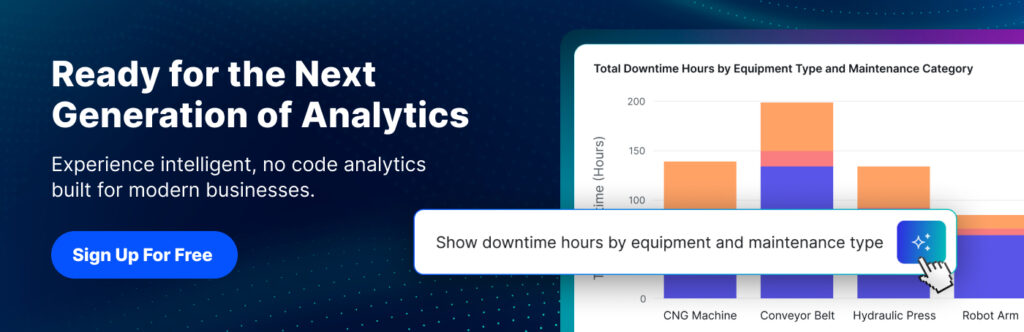
Analytics is becoming more conversational. Instead of navigating layers of filters or writing SQL, users want to ask questions in plain language and receive clear answers instantly.
Why Natural Language Matters
Business leaders, product managers, and operations teams do not want to depend on technical specialists for every question. They expect analytics platforms to understand context, business terms, and intent.
A modern platform should allow users to type questions such as:
“What drove churn last quarter”
“Which region is outperforming revenue targets”
“How did campaign performance compare month over month”
The system should translate these into accurate queries, generate visualizations, and provide meaningful explanations. This removes friction and democratizes access to data.
Transparency and Trust in AI Driven Insights
As AI plays a larger role in analytics, trust becomes critical. Modern businesses expect transparency in how insights are generated.
Explainable Query Logic
Leaders want visibility into the underlying logic behind results. Whether insights are generated automatically or refined through natural language, users need clarity on how numbers are calculated.
Platforms must allow users to understand and refine queries without introducing technical barriers. Transparency builds confidence and reduces resistance to AI-driven decision making.
Unified Data Across the Enterprise
Data silos remain one of the biggest challenges in organizations. Marketing data lives in one system, finance in another, product analytics somewhere else. Modern businesses expect analytics platforms to unify these sources seamlessly.
A 2026 ready platform should connect securely to databases, warehouses, and cloud storage without forcing data migration. In-place, querying ensures security while enabling cross source analysis.
When finance, product, and operations data can be explored together, leaders gain a holistic view of performance rather than fragmented insights.
Built In Data Quality and Governance
As analytics expands across teams, governance and data quality become non-negotiable.
Reliable Insights Start with Reliable Data
Executives expect platforms to automatically detect duplicates, missing values, anomalies, and inconsistencies. Data quality checks should not be manual tasks handled only by data engineers.
Modern analytics platforms must provide clear quality metrics at the column and row level, helping teams identify issues before they impact decisions.
Governance for Responsible Intelligence
Beyond accuracy, businesses expect strong governance frameworks. Role based access control, encryption, audit logs, and traceability are now standard requirements.
Organizations are asking a deeper question in 2026. Not just is our data governed, but are our intelligent systems governed. Platforms must support explainability, traceability, and alignment with business intent.
Self Service Without Complexity
Self-service analytics has been a goal for years. In 2026, it is an expectation.
However, self-service does not mean complexity pushed onto users. Modern businesses want platforms that are powerful yet intuitive. Creating dashboards, refining insights, and sharing reports should feel natural and collaborative.
Users should be able to generate insights, pin visualizations to dashboards, configure refresh intervals, and share results across teams without technical training.
True self service means enabling business users while maintaining enterprise grade standards.
Proactive Intelligence, Not Reactive Reporting
One of the biggest expectations in 2026 is proactive intelligence.
Analytics platforms are no longer expected to wait for questions. They should actively surface patterns, highlight anomalies, and suggest areas worth exploring.
AI driven agents that scan datasets and recommend relevant queries help teams discover insights they might not think to ask. This shift turns analytics from a passive tool into an intelligent partner.
Proactive systems help organizations move from reactive decisions to anticipatory strategy.
Scalability for Global Operations
Modern businesses operate across regions, time zones, and regulatory environments. Analytics platforms must scale accordingly.
This includes handling large volumes of data, supporting multiple workspaces, and managing user access across global teams. Scalability is not just about performance. It is about ensuring consistent intelligence across distributed organizations.
Platforms must support growth without requiring complete architectural changes as the business expands.
From Dashboards to Decision Products
In 2026, analytics is not about building more dashboards. It is about delivering decision-ready outputs.
Modern businesses expect platforms to provide contextual explanations, alternative visualizations, and clear recommendations. Insights should guide action rather than simply display data.
The focus is shifting from information consumption to decision acceleration.
Why Forward-Thinking Teams Choose Lumenn AI
Lumenn AI is built for the expectations of 2026 and beyond. It combines natural language analytics, real time data access, transparent SQL visibility, AI powered proactive insights, and enterprise grade governance into a single no code platform.
Business users can ask questions in plain English and instantly receive visual insights. Analysts can refine logic with natural language. Leaders gain confidence through built-in data quality checks and secure in place querying.
Lumenn AI does not just generate dashboards. It enables intelligent, explainable, and decision-ready analytics across teams. Whether you are scaling globally or optimizing operations locally, Lumenn AI helps you move faster with clarity and control.
If modern analytics is about speed, trust, and accessibility, Lumenn AI is designed to deliver exactly that.
The 2026 Analytics Checklist
By 2026, businesses expect analytics platforms to deliver:
- Real time access to live data
- Conversational natural language querying
- Transparent and explainable AI logic
- Seamless multi source integration
- Built in data quality and governance
- Self-service dashboards without complexity
- Proactive insight generation
- Enterprise grade scalability and security
Anything less feels outdated.
The Future Is Intelligent, Transparent, and Human Centered
Analytics platforms in 2026 must combine intelligence with usability. They must empower every team member to explore data confidently while maintaining governance and trust.
The most successful platforms will not just provide numbers. They will provide clarity. They will not just automate insights. They will make them understandable, adaptable, and actionable.
Modern businesses expect analytics that works at the speed of thought, adapts to change, and supports responsible growth.
The question is no longer whether your organization has analytics. The real question is whether your analytics platform is ready for 2026.