

In a world where organizations depend heavily on analytics and AI to guide decisions, trust in business insights has become essential. Leaders no longer ask whether they have data. They ask whether the data they rely on is accurate, reliable, and consistent. This growing need for trust is driving enterprises to rethink how they manage data quality.
AI-driven data quality is emerging as a critical capability for modern analytics. By continuously monitoring data, identifying issues, and adapting to change, it helps organizations build confidence in their insights and act with clarity.
Why Trust in Data Matters More Than Ever
Modern enterprises generate massive volumes of data across multiple systems such as databases, cloud platforms, business applications, and external sources. While this data holds enormous potential, it also introduces complexity.
- Incomplete or missing values
- Duplicate records across systems
- Inconsistent formats and definitions
- Outliers that distort trends
- Schema changes that break reports
When these issues go undetected, they erode confidence in analytics. Business leaders begin to question dashboards, teams rely on manual validation, and decision making slows down. In high stakes scenarios such as finance, healthcare, supply chain, or operations, poor data quality can directly impact outcomes.
Trust is the foundation of analytics. Without it, even the most advanced BI tools fail to deliver value.
The Limitations of Traditional Data Quality Approaches
Historically, data quality has been managed through manual rules, static checks, or custom scripts maintained by technical teams. While these methods worked in smaller environments, they struggle to keep up with today’s scale and speed.
Traditional approaches often suffer from:
- Rule definitions that require technical expertise
- Limited coverage across growing datasets
- Reactive issue detection after reports break
- Lack of visibility into row-level problems
- High operational overhead for data teams
As data volumes grow and analytics becomes more democratized, manual data quality simply cannot scale.
What Is AI-Driven Data Quality?
AI-driven data quality uses machine learning and intelligent automation to continuously evaluate datasets across key quality dimensions, without requiring constant human intervention.
Instead of relying solely on predefined rules, AI systems:
- Learn data patterns automatically
- Detect anomalies and deviations in real time
- Adapt to schema changes and evolving data
- Surface insights at column and row levels
- Prioritize issues based on impact
This approach enables organizations to move from reactive data cleaning to proactive data trust.
Key Dimensions of AI-Driven Data Quality
AI-powered data quality platforms evaluate data across several core dimensions:
1. Completeness
AI identifies missing or null values and measures how they impact key metrics. This ensures critical fields are populated before analysis.
2. Uniqueness
Duplicate detection goes beyond simple matching, identifying subtle duplication patterns that traditional rules often miss.
3. Accuracy
AI validates values against expected ranges, formats, and business rules—flagging invalid or inconsistent data.
4. Anomaly Detection
Machine learning models detect unusual spikes, drops, or distributions that may indicate errors or unexpected behavior.
Together, these dimensions provide a holistic view of data health.
How AI-Driven Data Quality Builds Trust in Insights
1. Issues Are Detected Before Insights Are Used
AI-driven systems continuously scan datasets, identifying problems before they propagate into dashboards or reports. This prevents flawed insights from reaching decision-makers.
2. Transparency at Every Level
Modern AI-powered platforms offer column-level and row-level drilldowns, allowing users to see exactly where and why data issues occur. This transparency builds confidence across technical and business teams.
3. Reduced Dependency on Manual Validation
By automating quality checks, AI eliminates the need for time-consuming manual reviews. Teams can focus on analysis instead of verification.
4. Consistent Quality Across Teams
As more users across the organization access analytics, AI ensures that everyone works from the same trusted data foundation, reducing conflicting interpretations.
5. Faster, More Confident Decision-Making
When stakeholders trust the data, decisions happen faster. There’s less hesitation, fewer approval cycles, and greater alignment across teams.
AI-Driven Data Quality in Self-Service Analytics
As organizations adopt self-service and no-code analytics platforms, data quality becomes even more critical. Non-technical users rely on automated systems to ensure accuracy without understanding underlying data structures.
AI-driven data quality enables:
- Safe self-service analytics for business users
- Reduced risk of misinterpretation
- Consistent governance without slowing exploration
- Scalable analytics across departments
This balance between accessibility and trust is essential for modern analytics platforms.
Operational Benefits Beyond Analytics
AI-driven data quality doesn’t just improve dashboards—it improves operations across the enterprise:
- Better AI models: Clean data leads to more accurate predictions
- Stronger compliance: Quality checks support auditability and governance
- Lower costs: Early detection prevents downstream rework
- Improved collaboration: Shared confidence in data reduces friction
By embedding quality into analytics workflows, organizations shift from firefighting data issues to enabling insight-driven growth.
Building Trust with Lumenn AI’s Data Quality Framework
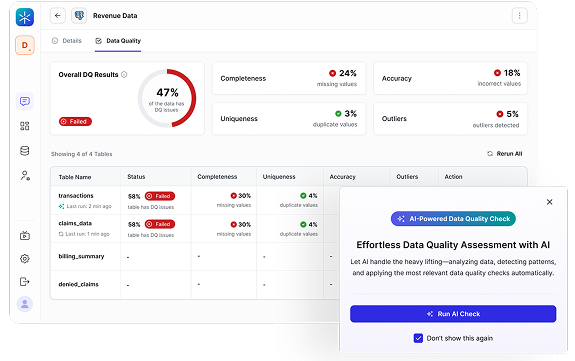
Lumenn AI integrates AI-driven data quality directly into the analytics experience. Instead of treating quality as a separate process, it becomes part of everyday analysis.
With Lumenn AI, organizations can:
- Automatically analyze datasets for completeness, uniqueness, accuracy, and anomalies
- View clear data quality scores at table and column levels
- Drill down to row-level issues for precise debugging
- Rerun checks after updates to validate improvements
- Enable trusted self-service analytics across teams
This approach ensures that every visualization, dashboard, and insight is built on a reliable foundation.
The Future of Trusted Analytics
As AI becomes more deeply embedded in business decision-making, trust will be the defining factor between success and failure. Organizations that invest in AI-driven data quality will be better equipped to scale analytics, empower users, and act with confidence.
The question is no longer whether data quality matters, it’s whether your analytics platform can continuously and intelligently ensure it.
Final Thoughts
AI-driven data quality transforms analytics from something teams question into something they trust. By detecting issues early, providing transparency, and scaling governance intelligently, it lays the groundwork for reliable insights and smarter decisions.